

KOPE
Innovation overview and development
An overview of the digital innovation
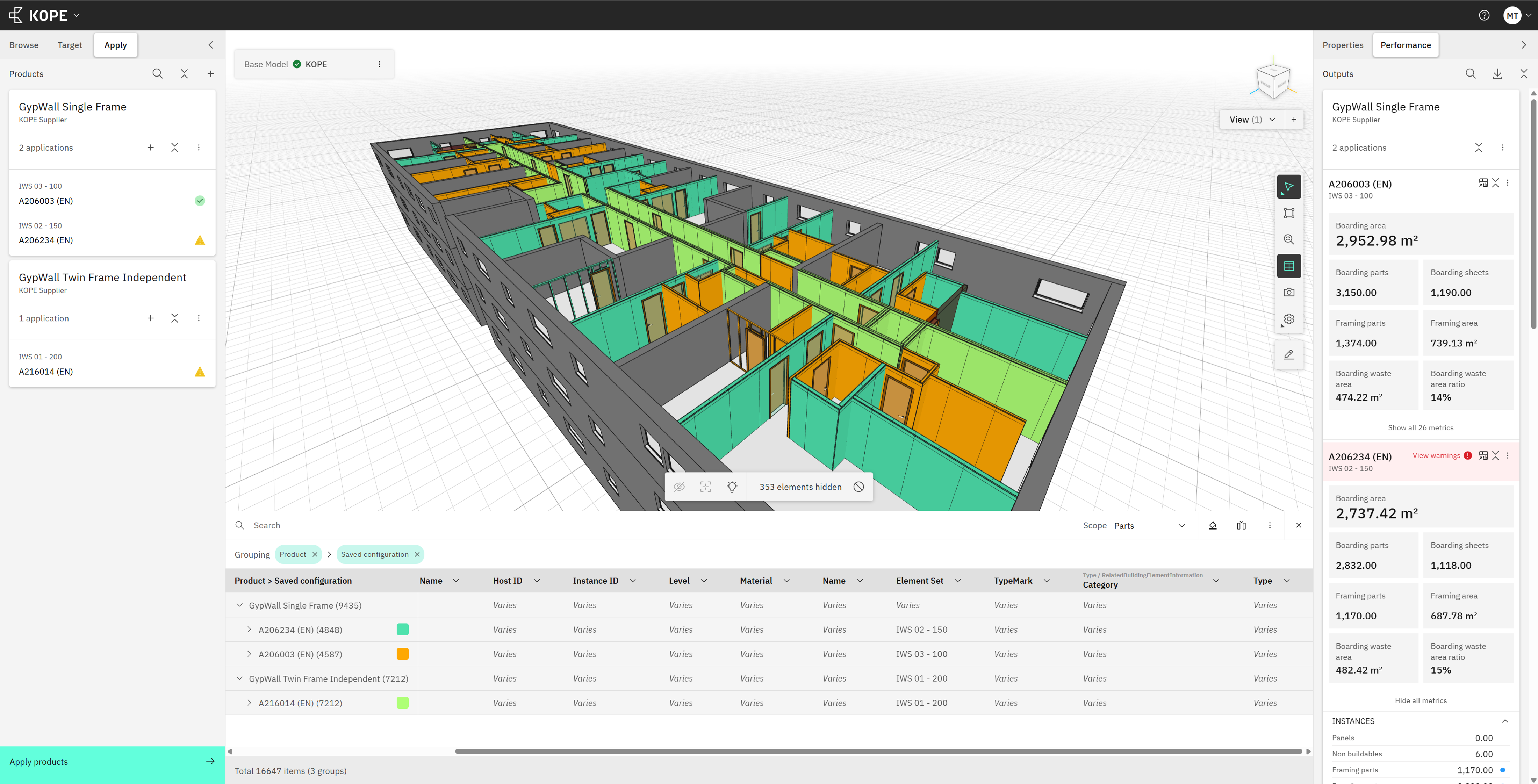
KOPE is an AI platform for productization, that transforms low-level 3D architectural design intent (simply 3d models) into highly detailed, manufacture-ready drylining geometry in seconds.
Specifically designed to address the high financial risk and cost volatility of internal partition packages, KOPE acts as a digital bridge between conceptual information and real-world manufactured systems. The platform automatically scans basic wall build-ups in models and instantly configures, optimises, and places every individual stud, track, board and insulation.
By integrating the physical rules, manufacturing constraints, and performance requirements of drylining assemblies directly into an automated cloud workflow, KOPE provides instant system-level compliance, automated high-fidelity Quantity Take-offs (QTO), and actionable waste-reduction insights long before site mobilisation.
How the digital innovation was developed, including effective collaboration, knowledge transfer and partnership along the project team
KOPE was developed by a cross-functional team of construction, design, and software experts who recognised that drylining has historically suffered from systematic failures in late-stage design management. Rather than building the platform in a software silo, KOPE has engaged with the entire supply chain, working closely with major tier-one manufacturers, main contractors, and specialist subcontractors across the UK and US.
In the UK, KOPE has onboarded systems from British Gypsum, Knauf, Siniat and more, distilling complex, fragmented product data sheets, system interfaces, assembly rules, and adjacent construction tolerances into an automated logic engine.
This approach ensures KOPE doesn’t just generate theoretical geometry, but dynamically applies real-world, system-certified product preferences directly to architectural models.
Details on the measurable commercial results
On a recent project in London alongside British Gypsum, Overbury and BPC, KOPE resulted in a 27% reduction in waste and carbon per m² for plasterboard. This was achieved by recommending shifting from standard board lengths to an optimised 2700mm board. This single intervention slashed the board waste intensity rate from 3.67kg/m² to 2.88kg/m², saving 4.8 tonnes of plasterboard from going to landfill on just two floors.
In parallel, KOPE has also proven to significantly speed up design development and production delivery by up to 40%, by saving thousands of hours of manual estimating and drafting. By generating manufacturing content earlier in the design process, KOPE is able to highlight design and construction risk, helping to coordinate critical studs and builders’ work openings (BWOs) prior to site startup, neutralising the traditional 10-20% cost impact of field modifications.
How does this innovation improve processes
KOPE completely disrupts the “business as usual” process of delivering the drylining package. Typically treated as a secondary downstream coordination takes where late-stage changes and deferred coordination are at the root cause of compliance failures impacting profitability. KOPE enables drylining considerations to be brought into RIBA stage 2 and 3, not only 4. The Building Safety Act and Gateways are enforcing more rigour, system-level design compliance required before construction starts and KOPE enables that for drylining, ensuring more problems are resolved before site work commences.
How might this innovation influence the specification
In alignment with the Building Safety Act, Gateways, and the new FIS Dry Lining Design Code of Practice, drylining must be specified and verified as an unbroken, complete system rather than a collection of isolated products. KOPE fundamentally shifts how specifications are enforced and maintained throughout the project lifecycle.
Because the platform embeds the strict rulesets of tested configurations, it ensures that substituting a proprietary stud or board for a generic or alternative brand is flagged immediately if it compromises design integrity, fire resistance, or acoustic ratings. KOPE forces drylining specifications to be brought forward into RIBA Stages 2 and 3 rather than being deferred to Stage 4 or 5. This empowers the specialist contractor to establish a bulletproof, contractually defensible source-of-truth model that ensures what is specified is exactly what is safely built.
Creation of novel internal systems to produce eco-innovation
KOPE converts sustainability from a compliance burden into an active commercial advantage. The platform features a novel, automated optimisation engine specifically programmed to reduce embodied carbon and minimise physical waste at the source.
Rather than relying on site teams to manually measure and cut standard boards, which drives the industry’s typical 12% to 20% waste rate, KOPE calculates optimal cut strategies and board sizes. Furthermore, the system evaluates carbon data alongside geometric outputs, providing real-time tCO₂e waste metrics per wall variant. By instantly calculating whether custom-length boards or prefabricated framing panels yield the lowest environmental footprint for a specific floor layout, KOPE creates a repeatable digital workflow that allows drylining contractors to hit strict circular-economy benchmarks effortlessly, with proven data-backed metrics.