

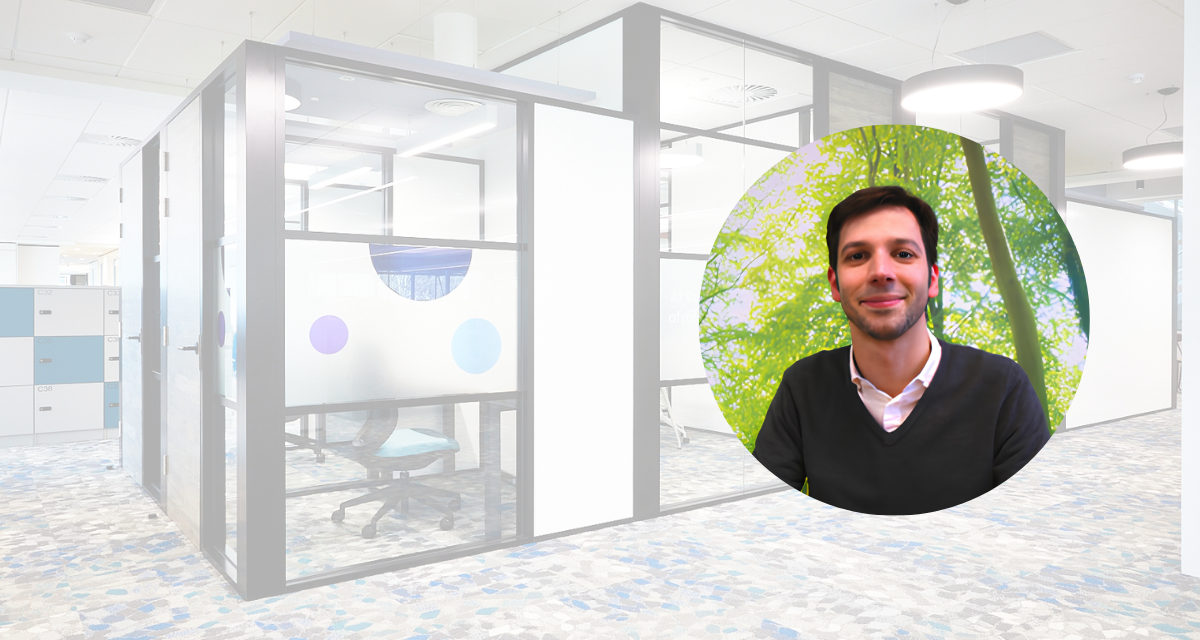
Office pods are flexible workplace spaces, but their acoustic performance is inconsistently tested and reported. FIS Technical Director, James Parlour, highlights industry perspectives and the development of a standardised, independently verified classification scheme to enable fair and consistent assessment.
Pods, by definition, are structures used to contain things — in this case, people. Crucially, they provide a temporary space to meet, think, talk, or simply be alone. Studies have shown that dedicated spaces for concentration and collaboration, away from the usual desk environment, can improve productivity. They reduce the risk of distraction and are often sold on the basis that they provide a level of privacy as well.
With names such as pods, booths, hives, kiosks, adaptable meeting rooms, and even campers and dens, these spaces evoke a clear sense of their purpose. They also appeal to a generation of workers who experienced similar environments and ways of working during their time in higher education.
Mollie Townsend, Sales Manager at The Meeting Pod Company, said that one of her key criteria when looking at potential employers was, “Can I work flexibly within a space, or am I likely to be tied to a static desk?” It seems that the trend for flexible working space that can be readily adapted is on the rise. A recent study showed that about 80% of all new fit-out projects will contain a “pod” or similar free-standing enclosed space, and, as the same survey suggested that there is 33 million square feet of office space under development, that represents a lot of opportunity.
“People are asking for flexible spaces that are easy to relocate, even ones that can be used outside.
“They want them to include lighting, power, charging points, comms, seating, work surfaces, and even AV screens and cameras. They also want them to have a feeling of privacy, though they can’t always vocalise what that means, especially where openfronted booths are concerned,” added Mollie.
Compliance
Due to the way pods are integrated into a fit-out, and their shared DNA with some larger furniture items, pods are sometimes understandably specified and procured in the same way as furniture, or under a loose furniture package, and are sometimes installed outside the oversight of the construction team. This model causes confusion about whether pods have implications for building safety.
This was explored in detail in an article called Approved Document B: Ensuring fire safety in office pods1, published in the January 2024 issue of SpecFinish, by Peter Long, Divisional Fire and Certification Director at Optima Products, with respect to reaction to fire. FIS have explored this further with the International Underwriting Association (IUA)2 to better understand the risks of freestanding pods not being assessed for their impact on Building Regulations and, therefore, regulated works.
Faye Hepburn, Underwriting and Claims Executive at IUA, said: “Whilst there remains some uncertainty about how Building Regulations can and will apply to pods, this does not change the underlying risk profile.
Where larger pods are being installed, it is vital that any impact on fire safety is effectively assessed, whether that be directly associated with the pod or indirectly associated with the location and impact of the pod on the Fire Safety Plan. It is critical that these risks are not ignored. Doing so could have potentially harmful safety implications and may impact upon the effective operation of the insurance coverage.
Acoustic performance of pods
Privacy can mean different things to different people. For example, in a quiet space with little background sound, sound insulation in an enclosed space may be required. Yet, in a busy, bustling space with a higher background noise level, sound absorption inside the pod is enough to reduce sound from conversations to below the sound level outside the pod, and privacy is maintained.
The way in which acoustic claims for larger meeting room pods are made varies. Some use test data for elements of the construction (often incomplete), while others use on-site data, which relies on the environment in which the product was tested and fails to provide comparable data. Either way, the inconsistency has proved difficult for clients to understand and for acousticians to interpret, leading, in some cases, to misleading claims of being ‘soundproof’, which cannot be evaluated.
In March 2021, FIS formed a Working Group which included Sandy Brown Associates, The University of Salford, Cundall, and several prominent manufacturers of freestanding pods. The first problem we identified is that there is no common methodology for testing and rating larger configurable meeting pods in the same way that there is for fixed partitions, where a specimen is tested according to a standardised method and a single Rw figure is derived in decibels (dB).
There is currently an ISO standard for rating the performance of small pods (ISO 23351-1:2020), which states that the test should be conducted in a reverberation chamber where the size of the pod is limited to no more than 5% of the test room volume, and the sample should be a minimum of 1 m from any wall or slab. Based on the dimensions of typical test facilities in the UK, this means it is not possible to test pods much larger than 11 m³ (in essence, a two-person pod).
Cutting through the noise
The FIS Working Group recognised that, unless this is addressed, claims outdoing competitors will lead to a race to the bottom, confusion in the market, and disappointed users. A new methodology, known as the Acoustic Classification Scheme, was jointly developed by the Working Group that will allow pod manufacturers to submit test data in a variety of forms that can be translated into a classification.
The FIS Acoustic Classification Scheme for configurable pods will align with ISO 23351-1:2020 Acoustics – Measurement of speech level reduction of furniture ensembles and enclosures – Part 1:
Laboratory method, and Ds,a which is consistent with the market and more accurately accounts for pod acoustics, not room acoustics. This will allow an equal and fair comparison between the performance data for all pods, regardless of size.
The acoustic classification of meeting pods aims to classify the performance based on airborne sound insulation values (Rw) of the five elements (four walls and a ceiling) or a site test (Dnt,w). The data will be analysed by either Cundall and/or Sandy Brown and then verified by the other to ensure robustness.
The scheme will include registration and listing of the results on the FIS website with a summary report for acousticians and access to a unique logo for manufacturers. The logo will indicate to an acoustician that there is data behind the classification allowing the acoustician to include the pods in their model and so predict a more accurate soundscape.
If you would like to consider having your products verified by the Acoustic Classification Scheme, please contact jamesparlour@thefis.org to discuss this further.
Source
1. https://heyzine.com/flip-book/SpecFinish_Jan24.html#page/10
2. www.iua.co.uk/
3. https://www.thefis.org/knowledge-hub/acoustic-classification-and-verificationscheme/
Talking about the Acoustic Classification Scheme Iain McIlwee, Chief Executive at FIS, said: “We have developed the Acoustic Classification Scheme in response to a growing demand from industry, who want to be seen as providing clear, independent and verifiable data, so that specifiers can select products with confidence.
“It’s similar to the Acoustic Verification Scheme3 that we developed with Cundall to verify the claims made in the operable and fixed partition sector. It means that specifiers can compare products, knowing that the claims are using a consistent method of test.”
Andy Parkin, Global Head of Acoustics at Cundall, added: “As practitioners, we need to know how pods will benefit a space and the people who use them. By their nature, pods have a variety of shapes, sizes and compositions; some are large enough for a group, some are small enough for one person; some have a lid with ventilation, some are opentopped and fronted. Because of this variety, the acoustic benefit will depend not just on the pod location relative to other activities but also on their orientation.
“There is currently no standardised method of determining the in-situ acoustic benefit of pods in their various orientations and configurations, which means that we cannot give our clients all the information they need. “By standardising an assessment method which will give information on pod performance, taking into account the way they are installed and used, this gives invaluable information to practitioners who advise clients on the effective use of workplaces.”
Ian Strangward, Managing Director at Architectural Wallsz and former Chair of the FIS Partitions, Pods & Doors Working Group, said: “COVID had a huge influence on the workplace. We are working and communicating more remotely, and when we are in the office, we are looking for enclosed, secure spaces where we won’t be disturbed. I think that ventilation and easy-to-clean, wipe down surfaces will be important too as we get back to working in offices.
