


New research from Oscar Acoustics has revealed a disconnect between industry confidence in meeting people’s acoustic needs and the point at which acoustics are actually considered in the design and construction process.
Seven in ten (70.4%) UK architects and construction professionals say they are confident they meet the acoustic requirements of everyone who uses a building, including neurodivergent people and those with hearing challenges. Yet the research suggests acoustics are often not given proper consideration until key decisions affecting how a space will sound have already been made.
Acoustics come too late in the process
The research, commissioned by Oscar Acoustics and conducted among 500 UK construction professionals and 250 UK architects, shows how late acoustics can enter the process.
Among architects, nearly six in ten (57.2%) say acoustics do not get proper attention until RIBA Stage 4, Technical Design, or Stage 5, Construction. By this point, decisions around layout and materials are largely settled, limiting the opportunity to design for sound from the outset and making problems harder to address later.
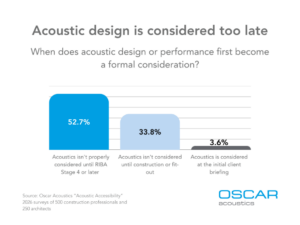
Construction professionals describe a similar pattern. Fewer than one in 25 (3.6%) say acoustics are considered at the initial client briefing stage, when there is still an opportunity to shape the fundamentals of a scheme. Meanwhile, around a third (33.8%) leave it until construction or fit-out, once the building’s shell is already up.
The consequences of getting acoustics wrong
Poor acoustic environments are estimated to cost UK businesses more than £40 billion a year* through lost productivity, staff turnover and customer dissatisfaction.
The impact is also felt by the people using these spaces. When acoustics are addressed late in the process, the needs and experiences of occupants risk being considered after many of the critical decisions affecting their environment have already been made.
Designing for people, not averages
Gillian Burgis Smith, founder of inclusive design consultancy Strawberry Leopard Limited and co-creator of the “Joyful Journey” methodology, has experienced this disconnect first-hand. Following two strokes and a brain tumour diagnosis in 2019, her own experience of the built environment changed profoundly, highlighting why environments must be shaped by lived and living experience, not assumptions about an “average” user.
She said: “The disconnect comes from confidence being mistaken for competence at implementation and that is where the gap opens up.”
“The profession is becoming more confident about the language of neuro-inclusive and sensory design, but less consistent in the systems needed to deliver it. You have to bring in people with lived and living experience, and design must adapt to the needs of the user, not the other way around.”
“In practice, that means testing designs with diverse users early and often, then iterating so spaces work for real people, not averages. A building is a dynamic ecosystem for a dynamic ecosystem of people.”
Where confidence and practice diverge
Ben Hancock, Managing Director of Oscar Acoustics, said: “While architects and construction professionals feel confident about meeting people’s acoustic needs, our research suggests there is a gap between that confidence and the point at which acoustics are considered in practice.”
“When acoustic design is considered as a late-stage addition, rather than a core element of the building strategy, it can have a severe impact on the people who use a space.”
“This is particularly the case for the 60% of UK adults who are noise-sensitive, including neurodivergent individuals and those with hearing challenges.”
“But poor acoustics also cost businesses directly, through lower productivity, higher staff turnover and reduced office attendance. The industry is taking a risk not only with people’s wellbeing, but with its own clients’ bottom line.”
Calls for greater industry support
The findings also suggest architects and construction professionals want more formal support around acoustic design.
Around one in six (15.8%) construction professionals and one in five (19.2%) architects back a recognised certification for acoustically inclusive buildings. Meanwhile, around one in five (19.4%) construction professionals and more than one in five (22.0%) architects want mandatory acoustic standards written into building regulations.
A framework for acoustic inclusion
Sownd Certification, developed by Sownd Affects, with independent testing carried out by the Institute of Sound and Vibration Research at the University of Southampton, is the world’s first framework recognising spaces with proven acoustic performance as audio-inclusive. It assesses spaces across three tiers, from Bronze foundations through to Silver and Gold, based on measures including reverberation time, background noise and speech clarity.
Oscar Acoustics’ Innovation Centre in Halling, Kent, is the world’s first Sownd Certified building, providing architects and specifiers with a working example of acoustically inclusive design in practice.
