

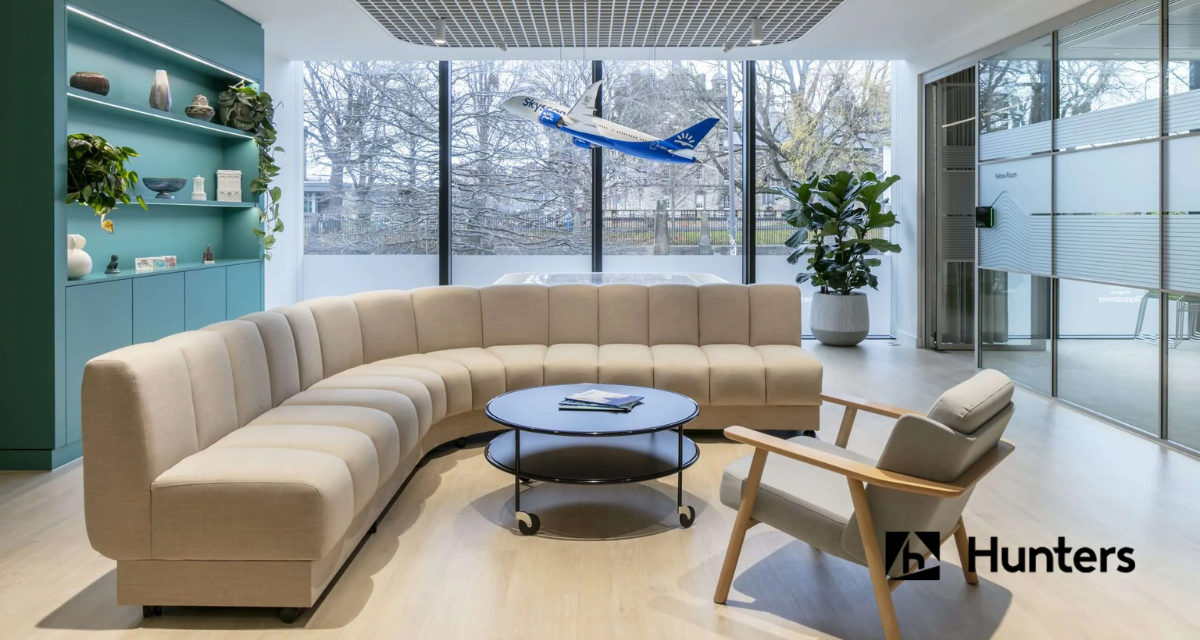
Skyscanner has delivered a project to reshape its Glasgow and Edinburgh offices. The goal was to create modern, homely and appealing workplaces that made time in the office feel worthwhile. Both locations were to become the company’s main Scottish hubs, offering calm, practical and welcoming environments that balanced focus, collaboration and comfort.

The brief was clear: no fixed desks, materials and finishes that reflected each city, flexible breakout areas to support different working styles, and strong acoustic performance to minimise distraction. Delivering this vision, however, required navigating complex logistics. Glasgow involved a full relocation from an older office into 1 West Regent Street, while Edinburgh required reconfiguring an existing space and consolidating from three floors to two. Both projects had to be delivered against shifting timelines and operational pressures, with minimal disruption to staff.
Fit‑out contractor BW Interiors appointed Hunters to deliver the furniture package, covering reuse of existing items alongside specification, procurement and installation of new furniture. Early involvement allowed Hunters to shape the reuse strategy, survey both sites and guide Skyscanner through product selection, budgeting and sample reviews.
Hunters’ furniture schedule spanned boardrooms, meeting rooms, pods, rugs, storage, plant liners, café and kitchen spaces, collaboration lounges, breakout areas, games rooms and reception furniture. Brands included OPM, Brunner, Allermuir, Senator, Connection, Tables for Business, Hawk, OB&B, Boss Design, Naughtone, Bulo, Howe and Expormim. The schedule ensured the brief was met efficiently, with options aligned to Skyscanner’s aesthetic and budget.
A significant challenge lay in managing the logistics of reuse. Existing assets, including task chairs, Framery phone pods, Mute meeting pods, tables, side chairs and soft seating, had to be decommissioned, stored, tracked and reinstated. In Glasgow, Hunters supported the transition from a multi‑floor office to a single consolidated floor, maintaining productivity throughout. In Edinburgh, one floor was decommissioned for fit‑out while another was intensified with additional desks, creating temporary arrangements that later became longer‑term solutions.
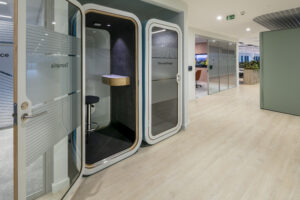
Meeting pods required specialist handling. Hunters coordinated directly with Framery and Mute, arranging for their fitting team to receive manufacturer training in mainland Europe. This ensured pods could be safely decommissioned and reassembled without damage, protecting Skyscanner’s investment in high‑value assets.
Originally, Edinburgh was due to complete before Glasgow. Enabling works began, with furniture removed and stored for reuse. However, an unexpected delay forced a programme pivot, shifting focus to Glasgow. This created overlapping timelines and unplanned complexity. Furniture intended to return to Edinburgh was diverted to Glasgow, and vice versa, turning the programme into what Hunters described as “a jigsaw puzzle” requiring constant coordination, subcontractor management and meticulous tracking.
Comprehensive inventories and multi‑warehouse storage underpinned the project’s success. Hunters’ ability to adapt plans, manage parallel schedules and maintain clear communication ensured continuity for staff and safeguarded client assets. The reuse strategy reduced costs and environmental impact, while the modernised facilities improved working conditions and consolidated operations.
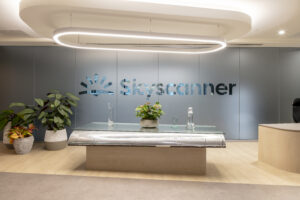
The Edinburgh office now features a strong emphasis on collaboration and community. A large town hall occupies nearly a quarter of one floor, supporting lunchtime gatherings, company‑wide meetings and informal breakout sessions. Recreational facilities such as pool and ping‑pong tables were stored and reinstated. Flexible lounges, café‑style areas and games rooms encourage informal interaction and relaxation.
Glasgow follows a similar approach, with a calm, practical layout that reflects the city and supports varied working styles. The open, flexible environment provides adaptability for teams and reinforces Skyscanner’s brand presence.
Together, the projects demonstrate Hunters’ capability to deliver complex workplace transformations, balancing logistics, design intent and cultural change while maintaining client confidence.
