

B-Test
Innovation overview and development
An overview of the sustainable innovation
B-Test: Using Evidence-Based Testing to Reduce Waste, Extend Asset Life and Improve Sustainability in Interior Construction
B-Test is an independent partition testing service developed by Betan to help contractors, manufacturers, consultants and building owners make more informed decisions about partition performance.
Traditionally, when partition systems fall outside manufacturer recommendations, are modified during construction or require performance verification, project teams often default to invasive investigations, over-specification, extensive remedial works or complete replacement. Whilst these approaches are intended to reduce risk, they can generate significant waste, increase embodied carbon and consume substantial project resources.
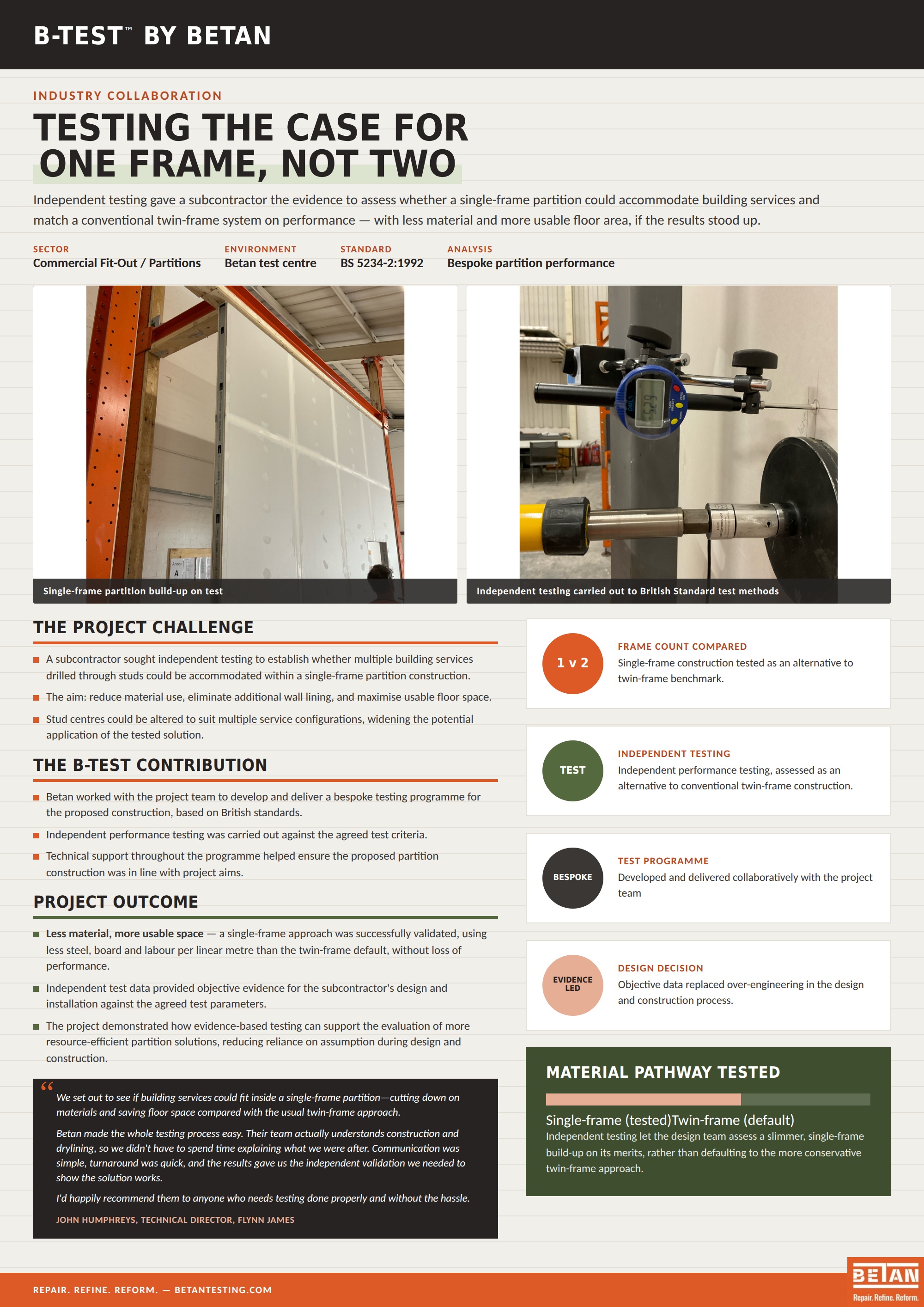
B-Test provides an alternative approach. Through laboratory and on-site testing against recognised British Standards, the service enables actual performance to be measured rather than assumed.
By replacing uncertainty with evidence, B-Test helps project teams avoid unnecessary demolition, retain existing assets where appropriate and make more sustainable decisions regarding refurbishment, compliance and future specification.
The innovation is not simply the testing itself. It is the use of performance data to support lower-carbon, resource-efficient decision making throughout the lifecycle of interior systems.
How the innovation was developed, including effective collaboration, knowledge transfer and partnership along the project team
B-Test was developed in response to recurring challenges identified through Betan’s involvement in partition testing, compartmentation reviews and construction defect investigations.
Across multiple projects, Betan observed that uncertainty regarding partition performance frequently resulted in conservative decision-making, including over-specification, extensive remediation and unnecessary replacement works.
The service was developed through collaboration with contractors, manufacturers, consultants, fire safety specialists and project teams who required a practical method of assessing partition performance in both laboratory and real-world environments.
Knowledge gained through robustness testing, fire performance assessments, product development programmes and live construction projects was used to develop a testing methodology capable of supporting both compliance and sustainability objectives.
This collaborative approach has enabled B-Test to evolve beyond a traditional testing service into a practical decision-making tool that supports manufacturers developing innovative products, contractors managing compliance risks and building owners seeking to maximise the value of existing assets.
The service continues to generate knowledge that is shared throughout the supply chain, helping improve partition design, specification and installation practices across the industry.
The use of new technologies, processes products or techniques or novel uses of existing ones
The innovation within B-Test is the application of recognised testing standards in a way that directly supports sustainable decision-making.
Whilst robustness testing standards such as BS 5234 are well established, they have traditionally been used primarily for product certification and laboratory validation.
Betan has developed a process that applies these testing methodologies to live construction projects, refurbishment schemes, product development programmes and existing building assessments.
This enables project teams to verify performance in real-world situations rather than relying solely on prescriptive guidance or precautionary assumptions.
Examples include:
• Testing oversized door openings and door weights beyond the limits defined within existing standards to support product innovation and development.
• On-site testing of completed installations to demonstrate compliance without invasive investigations or destructive opening-up works.
• Providing evidence to support retention of installed systems rather than replacement.
By transforming testing from a compliance exercise into a decision-making process, Betan has created a commercially viable service that delivers both technical and sustainability benefits.
How does the innovation provide a more environmentally friendly approach for the industry
B-Test supports sustainability by enabling project teams to make decisions based on measured performance rather than assumptions.
The environmental benefits are achieved through three key mechanisms:
Reducing Waste
Testing enables compliance and performance to be demonstrated before replacement decisions are made.
Where systems are shown to satisfy project requirements, unnecessary demolition and reconstruction can be avoided.
Extending Asset Life
The service supports retention and continued use of existing partition systems where performance can be verified.
This aligns directly with whole-life carbon principles by maximising the value of materials already installed within the built environment.
Reducing Embodied Carbon
Avoiding replacement eliminates the embodied carbon associated with manufacturing, transporting and installing new systems.
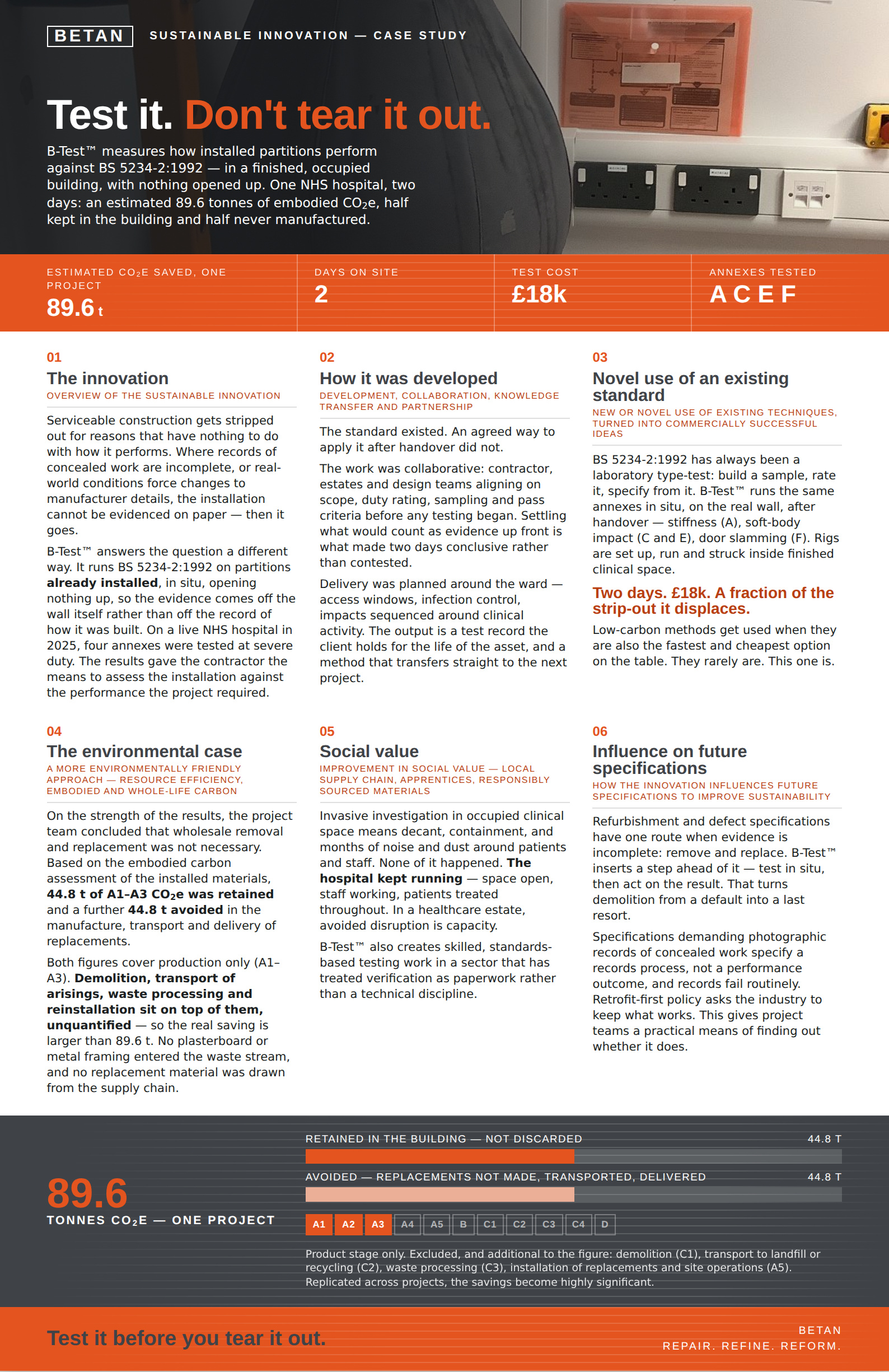
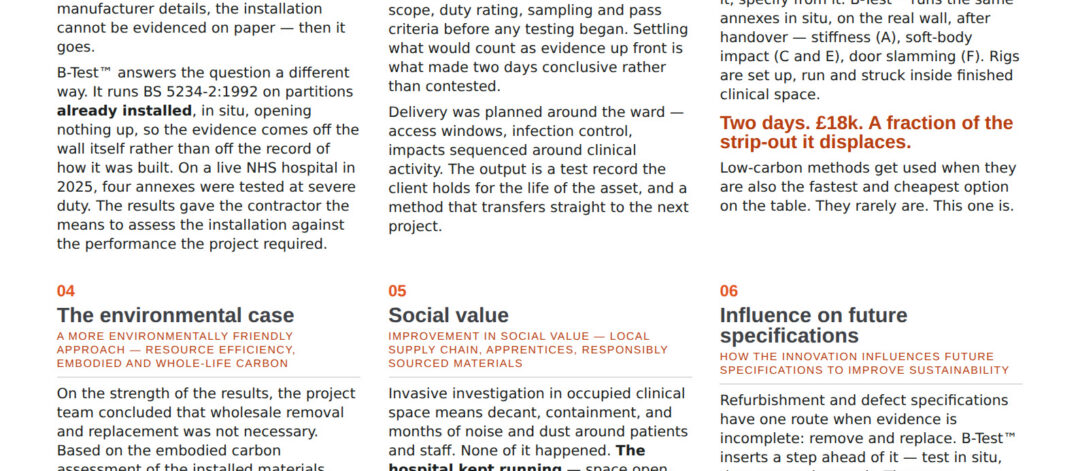
A recent NHS healthcare project provides a clear example. Testing demonstrated that installed partition openings met Severe Duty requirements despite concerns regarding opening dimensions and fire door weights. As a result, extensive remedial works were avoided, along with programme delays estimated at between six and twelve months.
Two days of testing, at a cost of £18,000, removed the need for a strip-out that would otherwise have sent an estimated 271 tonnes of plasterboard to landfill. Based on an embodied carbon assessment of the installed materials, 44.8 tonnes of A1–A3 CO₂e was retained within the building, with a further 44.8 tonnes avoided in the manufacture, transport and delivery of replacement materials — approximately 89.6 tonnes in total.
These figures cover the product stage (A1–A3) only. Demolition, transport of arisings, waste processing and the installation of replacement materials sit on top of them and remain unquantified, so the actual saving is greater than the figure stated.
The innovation therefore delivers sustainability benefits not by adding new materials, but by reducing unnecessary material use in the first place.
How does the innovation provide an improvement in social value
B-Test delivers social value through improved building safety, knowledge transfer and support for local industry.
The service provides independent evidence of partition performance, helping project teams make informed decisions regarding compliance, robustness and safety. This is particularly important in healthcare, education and public-sector environments where operational continuity and occupant wellbeing are critical.
The innovation also supports the development of new products and technologies within the interiors sector. Through product development testing, manufacturers can validate innovative solutions and bring them to market with greater confidence.
Knowledge generated through testing programmes is shared with contractors, designers and manufacturers, helping improve industry understanding of partition performance and encouraging higher standards of design and installation.
By supporting innovation, reducing waste and improving confidence in compliance, B-Test creates value across the wider supply chain
How does this innovation influence future specifications to improve sustainability
B-Test is helping shift the industry from prescriptive, assumption-based specification towards evidence-based specification.
Historically, uncertainty regarding performance has often led to over-specification or replacement. Whilst intended to reduce risk, these approaches can increase material consumption and embodied carbon.
By providing objective performance data, B-Test enables project teams to make informed decisions regarding:
• Refurbishment versus replacement.
• Appropriate robustness requirements.
• Retention of existing assets.
• Material selection.
• Compliance strategies.
The service demonstrates that sustainability can be improved not only through new products, but through better decisions.
As whole-life carbon assessment becomes increasingly important within procurement and design, the ability to verify performance and retain existing assets is likely to become an increasingly influential component of sustainable specification practice.
B-Test provides a practical framework for this transition by enabling evidence-based decision-making that reduces waste, conserves resources and supports lower-carbon outcomes across the finishes and interiors sector.
On a single project, evidence-based testing retained an estimated 89.6 tonnes of CO₂e and kept approximately 271 tonnes of plasterboard out of the waste stream, for £18,000 and two days on site. Replicated across refurbishment, compliance and defect projects, the cumulative effect on waste and embodied carbon becomes significant.