

Chalkstring

Innovation overview and development
An overview of the digital innovation
Introducing Chalkstring
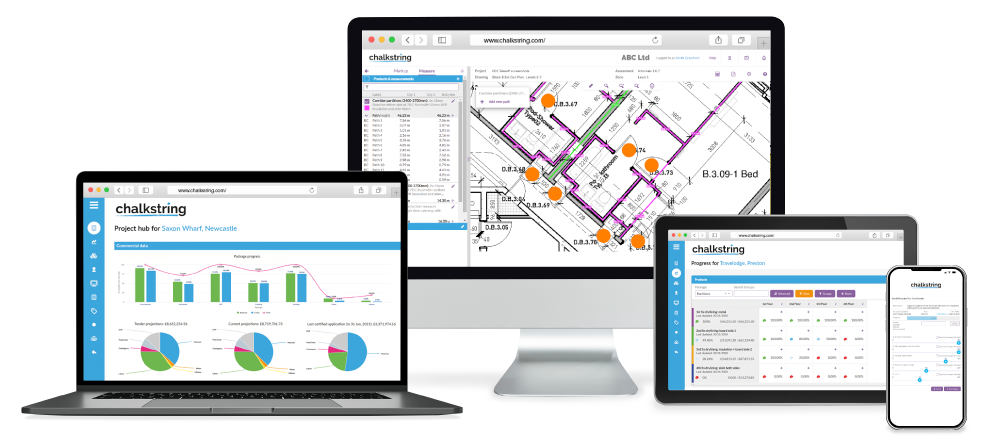
Chalkstring is a cloud-based cost management software platform. Developed entirely for interior fitout contractors, it improves how complex project financials are managed from initial pricing through to final account. It was originally developed for SCS Building Solutions Ltd and therefore meets the specific needs of specialist supply and fit subcontractors involved in interior finishes, fitout and refurb works.
At high level, Chalkstring is an integrated system that encapsulates the entire project lifecycle from estimating and takeoff, through to procurement, valuations, real-time reporting and much more. It is used as a collaboration platform by the whole project team, typically comprising estimators, buyers, quantity surveyors, commercial managers, directors, admin/accounts teams – and even site staff – streamlining processes and improving efficiency across the entire business.
Industry issues Chalkstring solves
The problem that Chalkstring solves is the age-old conundrum that blights construction – information being held in silos across multiple systems. The majority of contractors still use Excel worksheets for some or all of their financial management, and it’s widely accepted that spreadsheets are inconsistent, uncontrolled, and potentially carry significant risk of error. They also involve a lot of manual heavy lifting to manipulate or copy and paste data from one worksheet to another, further increasing inefficiency and risk. Even where contractors use some proprietary software solutions alongside spreadsheets, these will more than likely be point solutions that only do one thing and don’t talk to each other.
Digital innovations
Whilst Chalkstring as a whole is innovative as a focused end-to-end platform for fitout contractors, there are many unique aspects to Chalkstring which are highly innovative digital developments in their own right, for example:
• Real-time reporting – traditional cost reporting and accounting systems only report actual costs i.e. costs that have been incurred and signed off at that point. They don’t include the all-important accruals, such as committed material purchase orders and subcontractor work in progress. Without this information, cost value reconciliations are meaningless, and it’s a labour intense process to calculate this manually every month for every project. Chalkstring’s innovative coding automatically tracks and reports accruals, giving live and up-to date information in real-time.
• Integrated labour app – contractors need to process and approve potentially hundreds of labour applications every fortnight. This is a very tedious and labour intense process, given that applications are submitted in so many different formats, and many businesses have a dedicated team to do this. Chalkstring’s labour app is a ground-breaking application to enable subcontractors to book completed work and generate applications for payment ready for approval within Chalkstring.
• Final account projections – traditional cost reporting and accounting systems only report what’s been spent to date, not what is projected to the end of the contract. With ever changing contract scope and hundreds of variations & supplier prices fluctuating daily, it’s more critical now than ever to know what the projected revenue, costs and margin will be at completion – as well as the required balance of materials and labour, at any point during the contract. Without this information, contractors are flying blind and can’t easily make intelligent decisions. Chalkstring has been scoped and developed to include all future projections as part of the standard reporting functionality.
Key benefits and results
Chalkstring provides an innovative and more streamlined way of working. Ultimately the contractor still has to perform the same functions, but the WAY in which Chalkstring supports this leads to more efficiency and increased margins. The main benefits of Chalkstring revolve around a ‘Centralise, Standardise and Analyse’ philosophy:
• Centralised project data, accessible to everyone, on or offsite and in real-time
• One consistent system for the entire team across all project stages
• Defined processes & standardised documentation across the business
• Instant real-time 360° view of project commercials
• Compliance with quality procedures to support ISO accreditation
• Ability to control and analyse spend better, eliminating over-ordering & overpaying
• Ability to make informed decisions confidently and before it’s too late
To see Chalkstring in action, feel free to review our feature videos:
https://www.chalkstring.com/chalkstring-demo-videos
We also have a number of case study videos where clients discuss core features, as follows:
https://www.chalkstring.com/construction-software-takeoff
https://www.chalkstring.com/construction-estimating-software
https://www.chalkstring.com/construction-value-engineering-software
https://www.chalkstring.com/construction-procurement-software
https://www.chalkstring.com/construction-variations-software
https://www.chalkstring.com/construction-valuations-software
https://www.chalkstring.com/construction-subcontract-labour-software
https://www.chalkstring.com/project-cost-reporting-for-construction
How the digital innovation was developed, including effective collaboration, knowledge transfer and partnership along the project team
Chalkstring’s background
Chalkstring was the brainchild of our Product Director, Stuart Friend who, with a background in construction law, was horrified how multi-million-pound construction contracts are often managed using “back of fag packet” mentality, leading to inefficiency and lack of predictable outcomes. With years of commercial experience running construction projects at SCS, he identified the need for an integrated, single system. A system that enabled specialist subcontractors to manage project costs from end-to-end, standardise processes, eradicate over-reliance on personalised and disjointed spreadsheets, and allow for competitive value engineering.
Having scoured the market for a solution, Stuart soon established that all existing software either catered for the (very different) needs of a main contractor or focused on one specific task such as estimating. This conclusion then led to Stuart securing funding, writing a scope, and leading a development team to build Chalkstring. Once embedded effectively at SCS and with the positive impacts evident, Stuart then made the decision to take Chalkstring to the wider market, and a management team with over 120 years of experience in construction software was assembled in 2017 to achieve this.
Chalkstring now handles hundreds of millions of pounds worth of construction contracts daily, and to date has been chosen by over 130 fitout contractors within the UK alone.
Knowledge transfer and partnerships with clients
Our customers are at the heart of Chalkstring, and they continue to shape our ongoing innovation. We foster long term strategic relationships and strive to deliver unique solutions which solve industry problems and give our customers a competitive edge.
Our customers live and breathe construction, so we work closely with them to identify opportunities for innovation, such as our unique labour app which links to Chalkstring to enable subcontractors and gang masters to book work and generate the associated applications for payment.
We continually exchange knowledge with customers in many ways, including:
• Selected strategic “development partners” who participate in our focus groups. This typically involves sharing ideas at the concept stage of any new functionality, then embracing feedback at wireframe, alpha and beta build stages. This process ensures that we are not only reacting to what the industry wants but also providing it in a useable and effective format.
• Our feature request portal whereby clients can review our development roadmap and submit ideas for consideration, which can then be voted for by the wider customer base.
Delivering a software solution is only part of the puzzle; the key to success is an effective onboarding and support process. Even though Chalkstring is intuitive to use, what it is doing behind the scenes – managing highly complex financial data in highly complex construction projects with many moving parts – means it’s inherently a complex product. Having an experienced team with a construction background to deliver onboarding, training and support enables us to truly understand customers, help with change management and provide first-class technical support when needed.
Working with industry associations
We embrace collaboration with industry associations, such as the FIS and other similar organisations, to explore and understand the needs of the wider industry. We participate openly and actively in industry working groups to help tackle real life challenges using digitisation, such as inefficiency, excess waste, and more harmonious working throughout the supply chain.
We are responsive to changes in standards and legislation, for example the recent introduction of domestic reverse charge VAT – which was available in Chalkstring long before the legislation came into force – and where Chalkstring was used to help customers manage the painful transition.
Details on the measurable commercial results
Commercial success with Chalkstring is measured both financially, in terms of increased profitability, and also in terms of improved productivity. Our customers see impressive improvements once they’ve implemented Chalkstring. As an example, Jamie Brenton, Managing Director at Brebur Ltd, has provided the following statistics following their move to Chalkstring:
• Estimating is now twice as fast as it was previously using Excels
• Instead of taking half a day, valuations now only take 15 mins to produce
• Internal invoice queries have reduced by 95%
In fact, the demonstrable commercial results of Chalkstring manifest themselves in many ways. Maximised profit, making more money and saving money – what Chalkstring is all about – is achieved by the sum of many parts. Some are quantifiable and some are not, for example:
• No more over-ordering of materials and goods, or overpaying subcontractors (Proline Internals quote)
• Only paying suppliers for what’s been delivered
• Ensuring rebates are correct and that suppliers aren’t taking advantage (Drywall Solutions quote)
• Clearly substantiating valuations – results in less push back from main contractors and a better chance of being paid what’s been applied for (Brebur quote)
• Spotting where things are going awry and take corrective action early (SCS quote)
• Identifying the most profitable clients, thus being more strategic regarding who to work for (West Drylining quote)
A range of customer case studies which demonstrate the commercial improvements of implementing Chalkstring, can be found here:
https://www.chalkstring.com/customer-story-brebur-benefits-from-chalkstring
https://www.chalkstring.com/customer-story-scs-uses-chalkstring
https://www.chalkstring.com/customer-story-proline-benefits-from-chalkstring
https://www.linkedin.com/pulse/5-ways-which-our-client-increased-final-project-margin-barry-chapman/
How does this innovation improve processes
Standardised working methods + standardised documentation = better process
The more standardised a business is, the more efficiently it runs. Construction contractors are traditionally very unstructured, with everyone using their own bespoke worksheets and preferred methods of working. Compare this with other sectors such as banking or retail etc.
Chalkstring customers define standard processes by which the entire business operates, using one central database of project information, resulting in numerous improvements:
• Support for ISO9001 and other quality accreditations – Chalkstring makes it easy to document standard processes with defined ways of working. It’s then easy to train new staff and enforce because there is a standardised framework. We have helped many clients to write their ISO processes using Chalkstring, which demonstrates compliance for when they are audited
• Easier to recruit staff – new staff are easier to recruit and train as they “fall in line” with existing agreed processes and documentation. Jamie Brenton, Managing Director at Brebur Ltd, has found that, in the face of labour shortages, this has helped them to attract staff from outside the industry and train them up effectively
• Consistent documentation means that everyone knows what to expect and how to interpret it. From standard exported documents – like tender bills, applications, and purchase orders, through to cost value reconciliations – all staff work in the same way and produce the same formatted output, making it much easier to spot mistakes (Brebur quote)
How might this innovation influence the specification
Whilst it is not the role of cost management software to influence the contract specification per se, Chalkstring does help ensure that the correct specification is achieved from the outset.
By selecting standard specification templates from a company-wide central database, Chalkstring users can be confident that the compliant spec is being priced, and that all necessary material brands and specifics are included within both the rate build up and the subsequent material bill for procurement. This seamless flow of data eliminates any risk of error or misinterpretation; something that cannot be achieved easily by using manual spreadsheets, where data is often edited, manipulated, or overwritten.
Furthermore, if the contract allows, contractors may choose to provide alternative specification options as part of a value engineering exercise.
Chalkstring enables users to instantly swap specifications and materials. For example, to provide a compliant spec option as well as an unbranded option. Using traditional spreadsheets this is typically a very manual process which is prone to error; using Chalkstring it is a simple and fast process in which users can confidently yield significant savings with minimal effort.
Creation of novel internal systems to produce eco-innovation
Cost management software doesn’t really impact eco-innovation per se, so perhaps this question is not so relevant for a supplier like Chalkstring. However, there are many spinoff benefits of using Chalkstring which all contribute towards the sustainability agenda, however small.
Some examples include:
• Reduced material waste – contractors often place material orders based on “gut feel” as they don’t have accurate information available, yet they can’t afford to run short on site. This inevitably leads to considerable over ordering, and therefore wastage. Chalkstring accurately predicts the exact quantities of each material required in real-time, broken down across zones and with user-controlled waste allowances. This means buyers can confidently order only what’s needed without fear of generating excess waste. And with Chalkstring’s automatic conversion between measure (e.g. m2 of plasterboard), single item sizes (e.g. sheets) and bulk purchasing (e.g. pallets), ordered quantities can be optimised to minimise wagon deliveries.
• Fewer site visits – with site teams using Chalkstring, key data including logged issues, variations and monthly progress can potentially be captured onsite and clearly communicated to the commercial team remotely, resulting in less unnecessary travel and lower carbon emissions.
• Less material rehandling – when ordering materials by zone, Chalkstring automatically records which zone each material is destined for, and this is documented on the delivery schedule. This level of control means that materials can be distributed correctly onsite first time, thereby mitigating the need to move materials at a later date.
• Minimised requirement for hardware and paper – by moving to a centrally hosted system where all project data is stored within the cloud, the need to purchase and dispose of additional local hardware is greatly reduced, and the requirement to needlessly print out reams and reams of paper diminishes enormously.