

KOPE
Innovation overview and development
An overview of the sustainable innovation
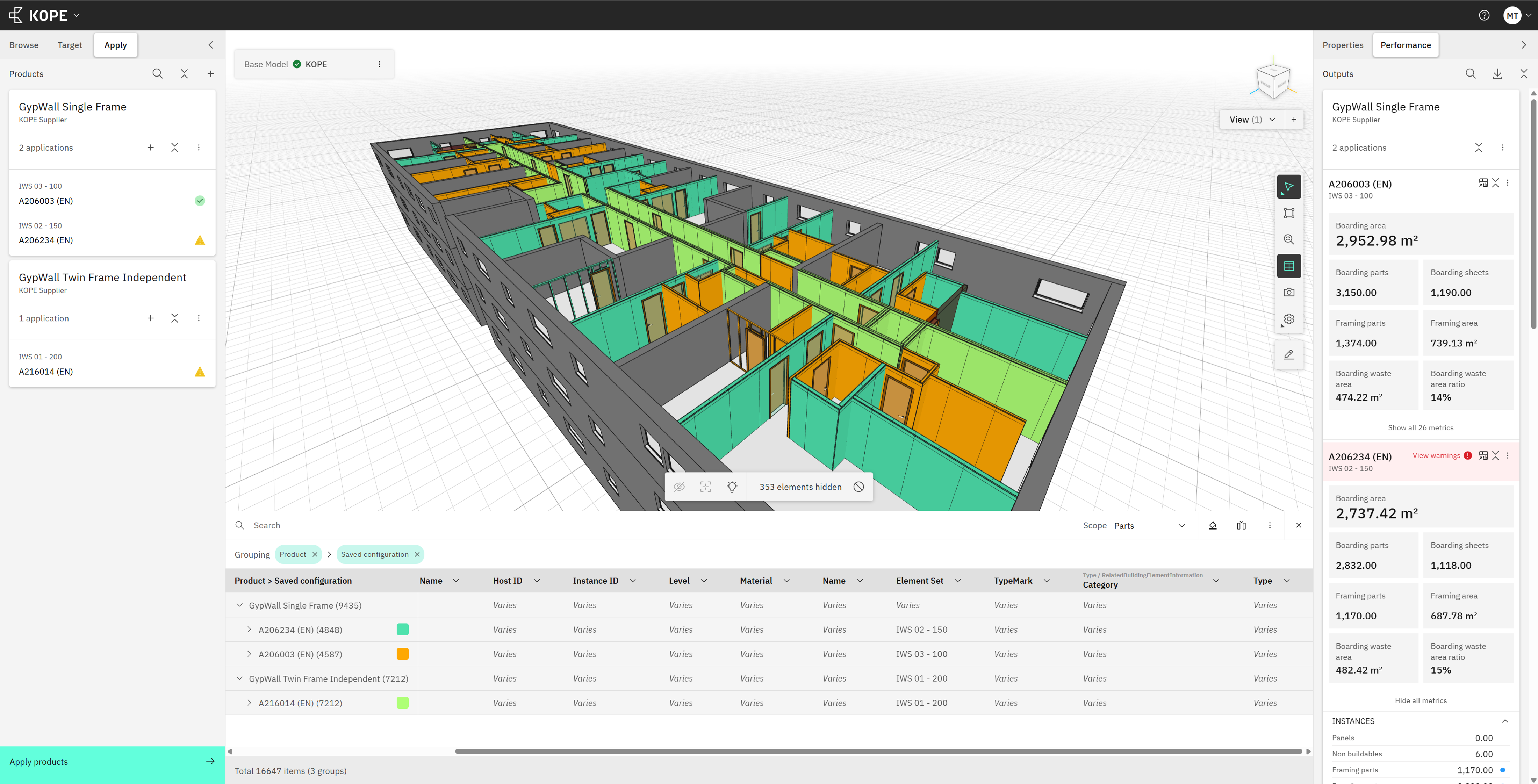
KOPE is an AI platform for productization that features a novel, automated optimisation engine specifically programmed to reduce physical raw material waste and reduce embodied carbon at the design stage of drylining and internal partition packages.
The platform automatically scans basic architectural wall layouts and instantly calculates the most resource-efficient placement of every stud, track, board, and insulation layer. By replacing arbitrary percentage-based site waste allowances with precise, data-backed cut strategies and bespoke sizing, KOPE moves the sector away from intensive downstream material modification and onto a path of true circular construction long before site mobilisation.
How the innovation was developed, including effective collaboration, knowledge transfer and partnership along the project team
KOPE was developed by a cross-functional team of construction, design, and software experts determined to tackle the 12-20% standard material waste allowance traditionally accepted as a “cost of doing business” in drylining. Rather than building the platform in a software silo, KOPE has engaged with the entire supply chain, working closely with major tier-one manufacturers, main contractors, and specialist subcontractors across the UK and US.
In the UK, KOPE has onboarded systems from British Gypsum, Knauf, Siniat and more, distilling complex, fragmented product data sheets, system interfaces, assembly rules, and adjacent construction tolerances into an automated logic engine.
This approach ensures KOPE doesn’t just generate theoretical geometry, but dynamically applies real-world, system-certified product preferences directly to architectural models.
The use of new technologies, processes products or techniques or novel uses of existing ones
KOPE introduces a disruptive, automated cloud workflow that turns sustainability into a direct commercial and operational advantage. Instead of relying on manual 2D take-offs and leaving site teams to manually measure, cut, and scrap standard boards, KOPE applies advanced algorithmic optimisation to 3D design models.
The technology instantly evaluates hundreds of layout scenarios, calculating whether custom-length boards, certain design strategies or differing manufacturing systems yield the lowest environmental footprint for a specific floor layout. It turns eco-innovation into a commercially successful strategy by allowing subcontractors to radically lower their material spend and reduce waste disposal costs, protecting thin margins while delivering mathematically optimised layouts directly to site.
How does the innovation provide a more environmentally friendly approach for the industry
In a recent prominent London project executed alongside British Gypsum, Overbury, and BPC, KOPE demonstrated its power as a highly resource-efficient solution, achieving a 27% reduction in waste and carbon per m² for plasterboard.
By dynamically analysing the geometric layout of the project, KOPE recommended shifting from standard board lengths to an optimised 2700mm board length. This single digital intervention slashed the board waste intensity rate from 3.67kg/m² to 2.88kg/m² and saved 4.8 tonnes of plasterboard from going to landfill on just two floors.
Furthermore, the platform evaluates live carbon data alongside geometric outputs, providing real-time tCO₂e waste metrics per wall variant. This replaces carbon guesswork with clear, auditable data, drastically lowering the whole-life carbon impact of the interior fit-out.
How does the innovation provide an improvement in social value
By automating the tedious, repetitive elements of manual estimating and drafting, KOPE elevates the role of the modern drylining professional. It provides a powerful digital toolkit for apprentices and up-skilling workers, transitioning them from manual labour or basic data-entry tasks into strategic “digital twin” managers and sustainability coordinators.
Furthermore, because KOPE embeds the strict rulesets of responsibly sourced, certified manufacturers (such as British Gypsum, Knauf, and Siniat), it ensures project teams cannot accidentally substitute verified, sustainably manufactured systems for unverified components on site.
How does this innovation influence future specifications to improve sustainability
In strict alignment with the new FIS Dry Lining Design Code of Practice and the Building Safety Act, KOPE influences future specifications by forcing sustainability and system-integrity checks forward into RIBA Stages 2 and 3.
Traditionally, carbon and waste optimisation were deferred to Stages 4 or 5, when changes are costly and difficult. KOPE allows specifiers to lock in optimised board lengths, minimised cut strategies, and lower-carbon system assemblies at the earliest stages of design. Because the platform embeds tested, complete configurations, it guarantees that any late-stage product substitutions that compromise fire, acoustic, or environmental performance are instantly flagged. This creates an unassailable, contractually defensible digital audit trail ensuring that the low-carbon system specified is exactly what is delivered on site.