

Vexbox


Innovation overview and development
An overview of the product
Vexbox is an intumescent variable extension box, for use where electrical back boxes have been set too far back into the wall or, there are gaps around the outside of the box and the wall aperture.
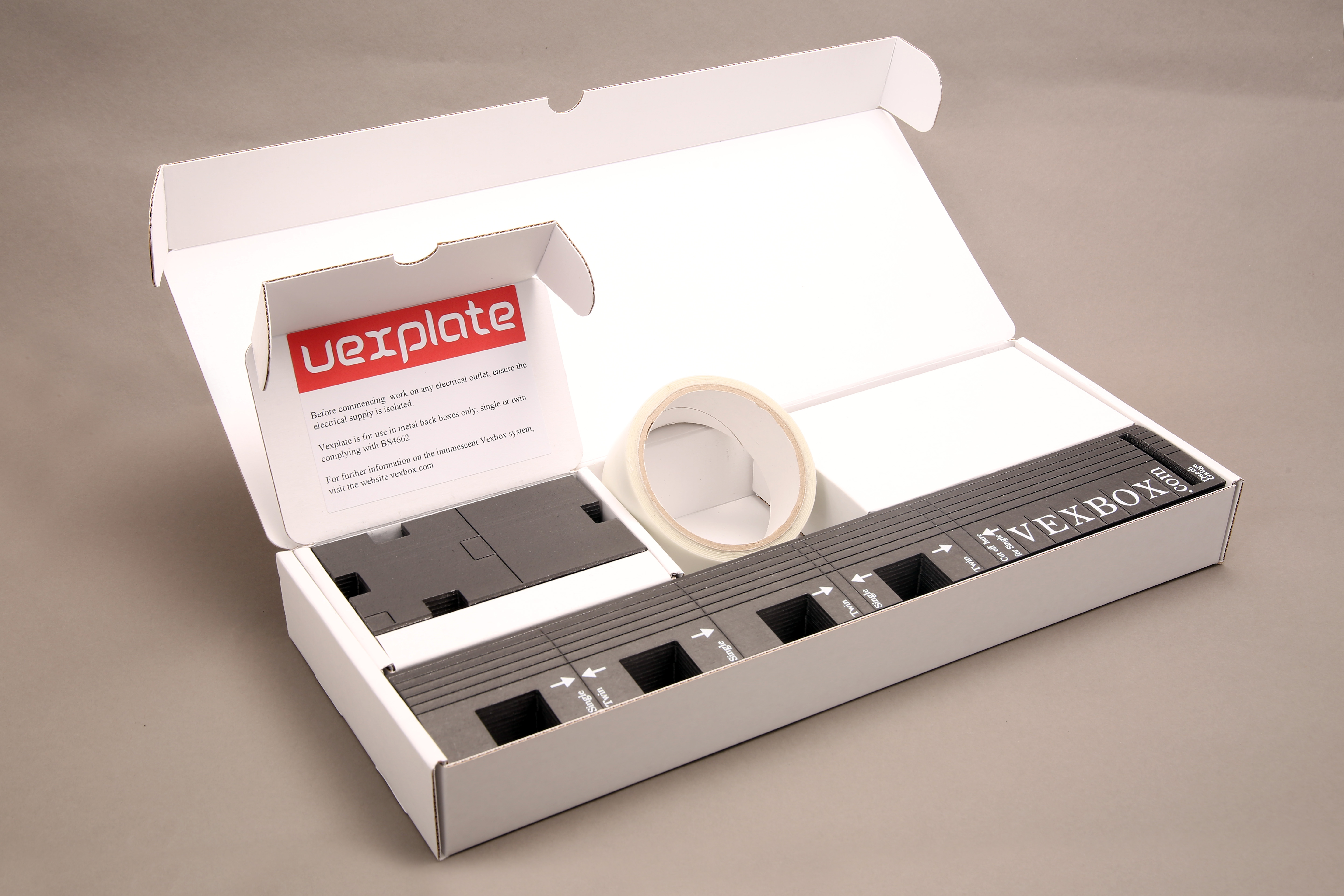
Vexbox can be formed into a single or twin profile and can vary from 5-35mm of extension. For use with 25, 35 and 47mm deep electrical back boxes
Where electrical back boxes have been set too far back into a partition wall or, there are gaps around the outside of the box, a Vexbox can be used to close the gap between the front of the box and the surface of the wall. This then reinstates the fireproof integrity of the wall and at the same time, provides an edge for the plasterer to work to thereby providing a superior quality wall finish.
How the new product was developed including effective collaboration, knowledge transfer and partnership along the project team
The intumescent version of Vexbox is a further development from the original V0 rated PVC version.
Whilst second fixing a new café for the Great Central Railway in Quorn, Leicestershire, it became apparent that, where the walls had been boarded “in a hurry”, there were large gaps around the outsides of the boxes and also some were set too far back into the wall making it very difficult to make the walls good. The only thing available to overcome this problem were metallic extension boxes which are of a fixed depth and either single or twin. What didn’t exist on the market was a template which could be formed into a single or twin profile and able to vary from 5 to 35mm of extension. The Vexbox was born.
It seemed an obvious step forward to develop an intumescent version that could maintain the fireproof integrity of a wall and at the same time, providing for a superior quality wall finish.
The original Vexbox was manufactured from PVC which was injection moulded. However, the high temperatures and pressures involved in injection moulding are the exact conditions that cause an intumescent compound to expand. So, the graphite based intumescent material couldn’t be injection moulded. The other problem was that extruding intumescent compounds requires specialist equipment as the polymers are very acidic and would destroy aluminium moulds.
The first problem to overcome was to find a material that was rigid enough to form a box but at the same time was flexible enough to be folded and could also be cut with a knife. This was looking like “a bridge to far” until a chance conversation with the Technical Director at Dugdale Polymers. They subsequently created a bespoke compound which satisfied all of the required criteria.
The polymer is supplied in pellet form and is then extruded into blanks measuring 420 x 70 x 2mm using specialist machinery including stainless steel dies. The blanks are then shipped to an engineering company in Leicester who made a forme which is similar in principle to one you would use to cut out mince pies. However the difference is that the forme is placed in an industrial press which then stamps the blanks extrusions into Vexbox templates.
As a result of in house testing, it was discovered that. Where gaps exist between the front of the box and the plasterboard wall, this provided an outlet for the expanding intumescent char. Therefore, instead of forming a dense barrier of char within the box , the char just flowed into the wall. Various methods and materials were tested to overcome this problem. The most effective solution to this problem was the patented “wrapping of fibreglass tape” to prevent the expanding char from flowing into the wall.
Along the way with the development of the new version there was input from graphic designers, website developers, screen printers for the text on the templates, packaging specialists. Photographers and Patent Attorney.
How might this product have influence on the specification
It is clearly laid out in many technical documents how electrical back boxes should be fitted into plasterboard walls. They all show boxes perfectly cut into the board with no gaps around the edges and perfectly flush with the surface of the plasterboard wall. In reality, this is very rarely the case. Therefore, by default, if boxes aren’t installed as per the technical documents then they are incorrectly installed which is more often the case and therefore need rectification.
Boxes which are incorrectly installed need a system which has been proven by test to reinstate or maintain the fire proof integrity of the wall.
The Vexbox system has been proven by test by both British Gypsum and Warrington Fire to maintain the integrity of a wall for over 2 hours under intense fire conditions when used in 25, 35 or 47mm deep electrical boxes even when there is a gap between the font of the box and the plasterboard wall.
How the product improved productivity in the process and/or quality and performance of the interior system
The main purpose of the Vexbox system is to enable fire rated walls with electrical back box penetrations comply with the building regulations. However, as well as complying with the regulations at the same time providing an edge for the plasterer to work to. By providing an edge, it makes the job of plastering quicker, easier and enables a higher quality wall finish making for a more aesthetically pleasing job as well as a compliant and therefore safe one.