

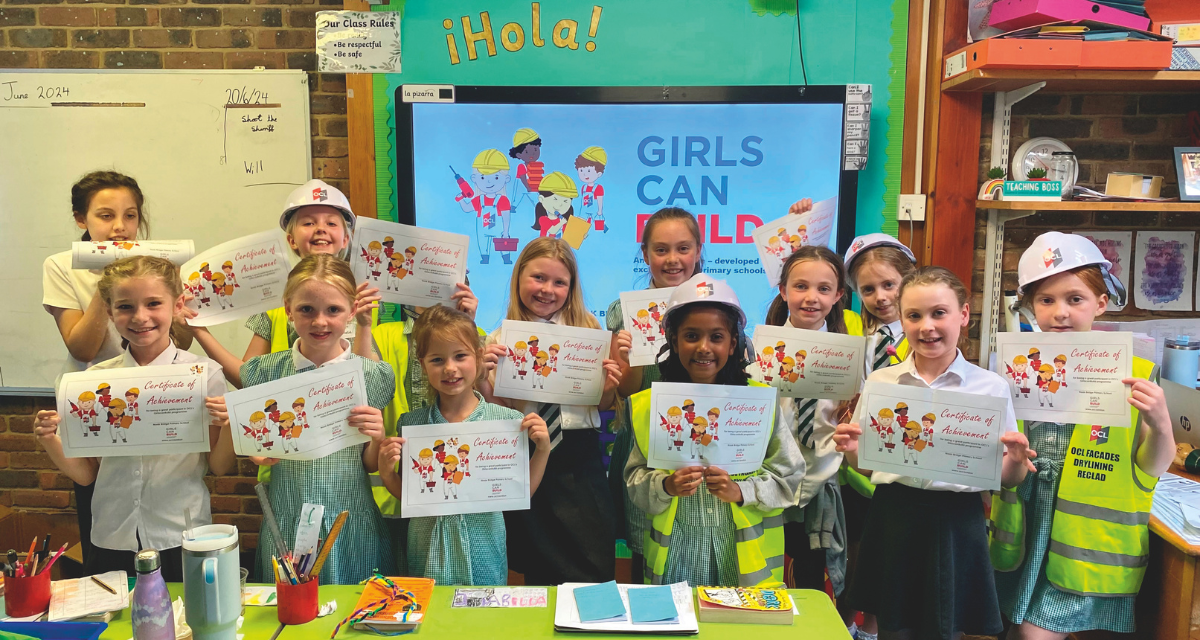
Varsha Patel, Marketing and Communications Lead at OCL Facades, shares with us the remarkable progress of their Girls Can Build programme.
OCL is a proud family-run construction business specialising in external facades, internal drylining and cladding remediation across complex residential and commercial developments. With more than two decades of experience, our teams work closely with developers, main contractors and design teams to deliver high-quality building envelope and interior solutions, supporting projects from concept through to completion. Built on strong unrivalled values we are committed not only to delivering exceptional buildings, but also to making a positive contribution to the wider
construction industry.
That commitment extends to investing in the future workforce that will shape our sector. Since its inception in 2024, the Girls Can Build programme has engaged more than 2,200 young people, from primary school pupils as young as seven to sixth form students in mainstream and special educational needs and disabilities (SEND) schools, challenging outdated perceptions of construction and opening eyes to the breadth of opportunities within our sector.
The impact is measurable
Girls Can Build is not a pilot idea or a one-off social value activity. It is an exciting and much needed movement, and the numbers reflect that momentum.
A total of 2,255 young people were engaged from 2024 to 2025, with 1,267 participating within the first 12 months, 883 engaged during 2024, and 1,372 participating in 2025. Growth has not plateaued – it is accelerating. We have now partnered with 18 schools, including 13 primary schools, 4 secondary schools, and 1 SEND school. This breadth is important. True inclusion means ensuring exposure across different ages, abilities and educational settings, not just traditional pathways.
To deliver this impact, these brilliant Girls Can Build advocates have facilitated 45 structured sessions and contributed 249 hours of volunteered time, alongside their demanding day jobs and with full support from OCL Facades.
Behind every statistic is a professional giving their time, sharing their experience and actively reshaping how young people perceive our sector.
These figures demonstrate more than reach. They demonstrate commitment. They demonstrate consistency.
They also show that when the industry takes responsibility for its own pipeline, meaningful change is possible. At primary school age, perceptions about “what jobs are for me” are already forming. When 98% of girls leave a session excited about construction, we are not just delivering an assembly – we are shifting mindsets at the point they are being shaped. For our industry this is where we need to plant the seed and help bridge the gender parity gap that continues to widen.
Pupils taking part loved the positioning and framing of the sessions, with their comments reaffirming the effectiveness of the delivery:
• “Dressing up was so much fun.”
• “It was interesting to learn about the varied jobs.”
• “I loved everything!”
• “I can’t wait to tell my dad about today.”
What stands out is not just their enjoyment, but their growing awareness.
Tackling the “Low paid, long hours graft” perceptions
When we launched the secondary school provision last year, one message came through loud and clear: many teenagers still see construction as low-paid, physically exhausting work with long hours and limited progression. For many girls in particular, it simply does not feel like a career path for them.
The reality, however, is very different. The construction sector in the UK employs over 2 million people. While the industry has historically been male-dominated, women now represent around 15% of the overall construction workforce. They remain significantly under-represented in sitebased roles, however, making up only around 1% of the on-site manual workforce. That perception gap is exactly what Girls Can Build addresses, for teenagers putting the focus on allyship at the forefront.
Through interactive assemblies and workshops, we demystify the many avenues open to young people by showcasing roles and pathways beyond hands-on construction – from design, project management, and surveying to estimating, health and safety, finance, and marketing. Not all roles require university qualifications, yet they can be equally, if not more, rewarding. For today’s Gen Alphas, the salaries associated with construction roles are often the biggest eye-opener.
Girls are beginning to understand that construction is diverse, creative, technical, and full of progression opportunities. There is a place for girls, with roles to suit every interest and every strength.
Breaking stereotypes and bridging the construction skills gap
The construction industry faces a significant skills shortage, with an urgent demand for new talent. Estimates suggest that the UK will need to recruit hundreds of thousands of new construction workers by 2027 just to meet workforce demand.
At the same time, the workforce is ageing rapidly: around 35% of current construction workers are over 50, and large numbers are expected to retire in the next decade. Without a pipeline of younger recruits entering the sector, meeting future demand will become increasingly difficult.
Diversity also lags behind the wider population. Only 6% of construction workers come from a minority ethnic background, compared with around 13.8% in the broader UK workforce.
When these figures are considered alongside the fact that 98% of primaryaged girls left our Hackney sessions excited about construction, the importance of early intervention becomes clear. The issue is not interest. The issue is exposure.
Opening young minds to construction careers
Feedback from schools has been overwhelmingly positive. Many now request a presence at careers fairs and enrichment days, describing the assemblies as “essential.” One teacher commented: “Girls Can Build was fantastic. The girls came away from the assembly and workshop enthused about the possibility of careers in construction and engineering. It was great that they were given the opportunity to see careers that perhaps they had not considered in the past.”
That phrase — “careers they had not considered in the past” — perfectly captures the purpose of the programme.
There remains a significant information gap within careers education. Too often, guidance still defaults to perceived “traditional” pathways, with construction rarely presented as a viable or attractive option — particularly for girls. Yet when young people are given clear information about the roles available, the training routes and the earning potential within the sector, many express genuine interest in pursuing these careers.
At a time when the industry faces an ageing workforce, a growing skills shortage across both trades and technical professions, and the continued under-representation of women and diverse communities, broadening access to accurate careers information has never been more important.
By bringing construction directly into classrooms, Girls Can Build is helping ensure that the next generation sees the sector not as an overlooked option, but as a dynamic industry full of opportunity, progression and purpose.
Leadership perspective: A commitment beyond commercial return
For OCL Facades, Girls Can Build is not driven by commercial gain.
As an SME, committing time, people and resource is a conscious decision, and one that reflects the company’s long-term view of the sector.
James Harris, Managing Director at OCL Facades, explains: “We’re an SME. Every hour our team spends delivering Girls Can Build is time away from project delivery, tenders or commercial activity. There is no direct financial return on this programme, and that’s exactly the point.
“We care deeply about the future of our industry. We’re operating at a time when construction faces a widening skills gap, an ageing workforce and persistent underrepresentation of women and diverse communities along with Gateway 2 and BSR challenges. If businesses like ours don’t step forward and invest in the next generation, we can’t expect the problem to fix itself.
“This isn’t about ticking a social value box. It’s about taking responsibility for the sector we’re part of. As an SME, we may not have the scale of a tier one contractor, but we have influence, we have passion and we’re choosing to use it.
“The return we’re looking for isn’t financial. It’s cultural. It’s about ensuring that in ten years’ time, there is a stronger, more diverse talent pool coming into construction. But for that to happen at scale, the industry needs collective buy-in. One company can make an impact but together, we can change the narrative entirely.
