

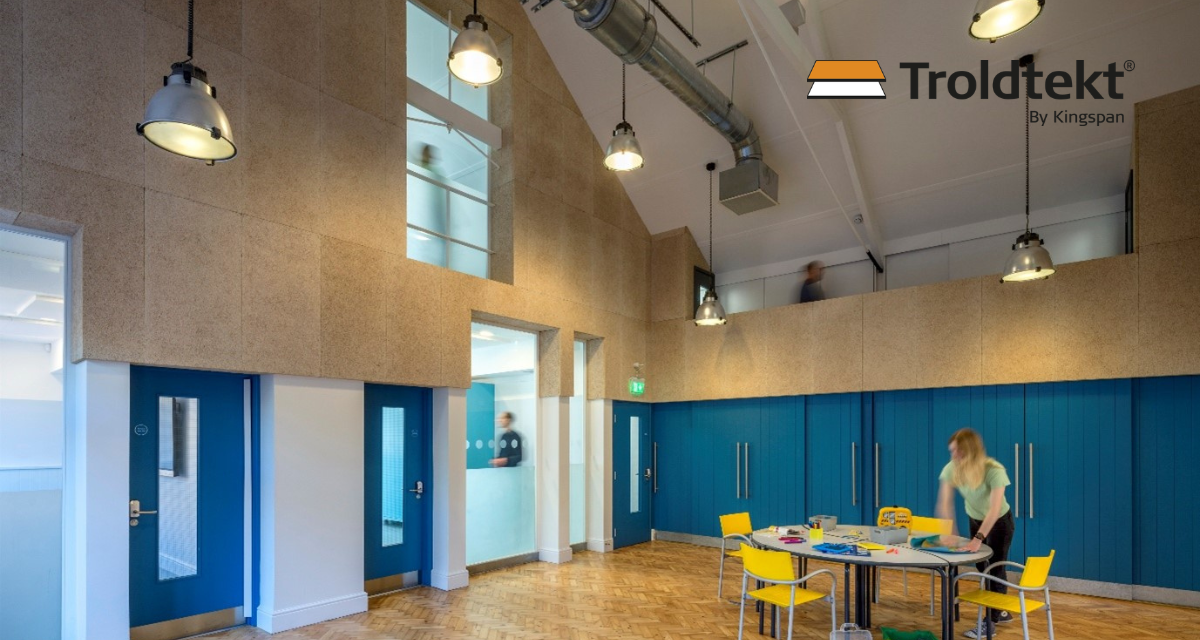
Robbie Herrick, Area Sales Manager for Troldtekt acoustic solutions, expands on the legal framework and standards for acoustical performance within educational environments to ensure compliance with Building Bulletin 93 (BB93).
The introduction of Building Bulletin 93 (BB93): Acoustic Design of Schools was introduced back in 2003 (and updated in 2014). Its primary aim is to ensure that the acoustic environment in schools supports effective teaching and learning, covering aspects such as background noise, sound insulation, reverberation time and speech intelligibility. It is designed to promote the acoustical health and well-being of both students and teachers.
The standard sets out mandatory acoustic performance standards for not only all new school buildings but refurbished ones and, indeed, modular and temporary classrooms in use for more than 28 days. It falls on the architect to incorporate BB93 standards in their design but also the fit-out contractor to ensure their construction practice meets the standards.
More often than not, acoustic consultants will be employed to ensure compliance is met, but frequently this is overlooked when applied to smaller refurbishment projects or temporary solutions such as offsite constructed classrooms. Although Building Regulations do not apply to all alteration and refurbishment work, it is deemed best practice that works should include acoustic consideration. In addition, Regulation 4 of the Building Regulations requires that any building work on an existing school should not make an existing requirement or contravention any worse than before building work was carried out.
Furthermore, The Equality Act 2010 places a duty on all schools and local authorities to prepare and implement accessibility strategies and plans to increase over time the accessibility of schools for disabled pupils and staff. Pupils with special educational needs are generally even more sensitive to the acoustic environment than others. Consequently, required reverberation times are shorter, sound control between adjacent spaces is higher and indoor ambient noise levels (and the capacity for distraction) lower than in environments for other pupils.
Pupils with hearing impairment, autism and other special needs are often very sensitive to specific types of noise, particularly those with strong tonal, impulsive or intermittent characteristics. BB93 says this should be taken into consideration in the design of areas which may be used by such children.
Why are acoustics important?
It is well known that classroom acoustics play a crucial role in the quality of teaching and learning. Good acoustics ensure that students can hear clearly, concentrate effectively and engage fully with the teacher and their fellow students.
The impact of noise pollution in classrooms on learning outcomes has been well documented over decades, with significant reports emerging as early as the 1970s. For example, Bronzaft and McCarthy (1975) conducted a study which indicated that New York City students were hampered in their reading skills by elevated noise levels. Students 70 metres from an elevated subway track lagged behind their peers, on the quieter side of the building, between three months and as much as one year. In 1986, Cohens, Evans, Krantz and Stokols found that some children from noisy schools had higher blood pressure, less cognitive task success and greater feelings of helplessness and Shield and Dockrell (2008) found that children in noisy classrooms exhibited lower reading scores compared to those in quieter environments.
One of the latest studies was by the European Environment Agency which published a report in December 20241, which reported on the impact of environmental noise on children’s reading ability and behaviour. The key messages being:
- Children living or attending school in areas impacted by transport noise tend to score lower on reading comprehension and face more behavioural challenges.
- Over half a million children in Europe experience impaired reading ability due to environmental noise from road, rail and air transport.
- Almost 60,000 cases in Europe of behavioural difficulties in children are due to environmental noise generated from transport.
- Those cases of impaired reading ability and behavioural difficulties can be largely prevented through interventions to reduce environmental noise at homes and schools.
For teachers, an acoustically poor environment can lead to vocal strain and fatigue due to raising their voices over background noise. For students, background noise, excessive reverberation and poor sound insulation can make it difficult to hear and understand their teachers, leading to increased cognitive load and reduced concentration. This is particularly compounded for those with hearing impairments or those students with English as a second language who may find it particularly challenging to follow lessons in acoustically poor environments. It’s all about speech intelligibility.
Reverberation times in classrooms
For Primary Schools in the UK, BB93 cites that new classrooms need to have a reverberation time of <0.6 seconds between 500hz-2000hz. For refurbished classrooms it’s a little more tolerant, permitting <0.8 seconds and <0.6 seconds respectively. In Secondary Schools, a reverberation time of <0.8 seconds between 500hz-2000hz is permissible rising to <1.0 for refurbished spaces.
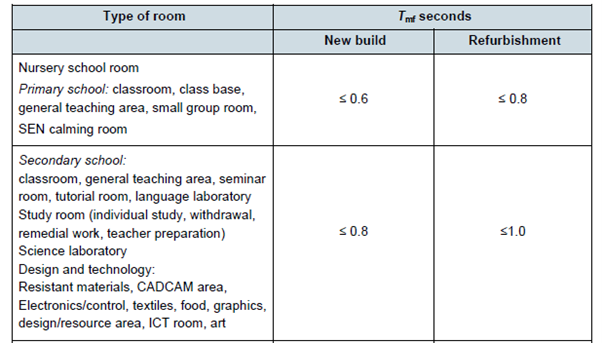
BB93 however does go further. It lists acceptable reverberation times across different spaces within a school, from libraries, assembly halls and dining rooms to dance studios, swimming pools and sports halls.
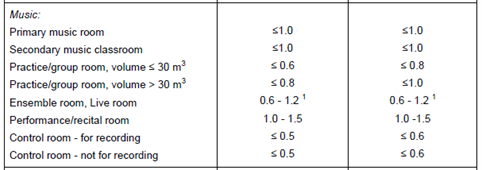
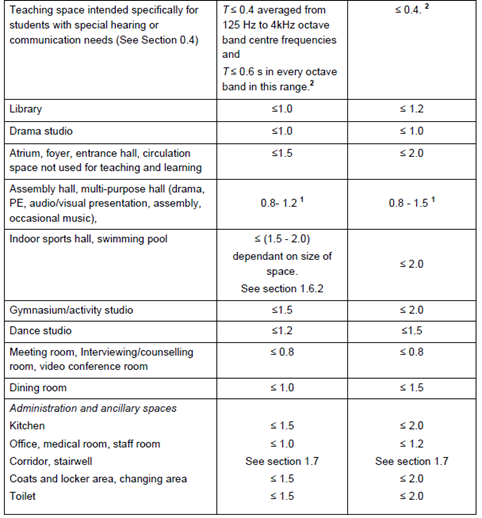
(In sports halls, the maximum reverberation time reduces from the 2 seconds to 1.5 seconds for floor areas of less than 280m2).
It’s all about ‘Speech Intelligibility’
The intelligibility of speech depends both upon clarity as well as audibility. Audibility is affected by the loudness of the speech (signal) relative to the background noise level and is expressed as a signal-to-noise ratio (SNR). Background noise is the combined noise from external sources such as road traffic and aircraft to internal noise from HVAC services, adjacent rooms and hallways and general occupancy. An SNR ratio of at least +15db is recommended rising to +20-25db for children with impaired hearing loss.
Solutions and best practices
To ensure compliance and to provide the best possible practices and outcomes for learning, Acoustic Consultants are frequently employed on projects. However, where this is not possible, detailed guidance and support is available from acoustic product manufacturers.
Companies, such as Troldtekt, offer technical guidance and support for contractors to make sure the correct level of acoustic control for each project. They even offer a free acoustics calculator that generates a precise overview of reverberation time, absorption area as well as other relevant information.
Costs and benefits
It’s worth noting that acoustic panels can often be a cheaper solution than installing traditional boards which need to be installed, skimmed and painted.
Acoustic panels can be mounted directly onto battens on ceilings and walls (which provide less acoustical performance) or, ideally, into suspended solutions where it’s possible to achieve Class A sound absorption while providing easy access to the services above.
And finally, as we all continue to strive towards the goal of best modern building practices, it’s also worth noting that controlling acoustics in classrooms can help contribute acoustic credits Hea05 and Pol05 in order to obtain BREEAM ratings.
Acoustics in practice
A good example is Snowflake School in Ealing. Here, Patalab architects were commissioned to convert an interesting old building off Acton High Street into a new certified school for children with Special Education Needs and one with a special focus on pupils with severe autism. Snowflake School is an Ofsted-outstanding teaching environment in a building which was originally a purpose-built hall for the Salvation Army before being turned into an animation studio. Inserted steelwork mezzanines over a herringbone-floored hall contributed to a mishmash of conversions.
Given the nature of the school and the links between autism and noise sensitivity, Troldtekt’s acoustic wood wool panelling was specified to minimise sound reverberation and to promote a healthy sound environment and calmness.
Project Architect Sophie Fuller explains “The double-height central space works really well as the school’s main hall. In order to minimise sound reverberation, we chose to clad the upper half in acoustic panelling made from wood wool. The texture and neutral colour of the panelling also help to make this tall space feel friendlier and warmer.”
Source
