

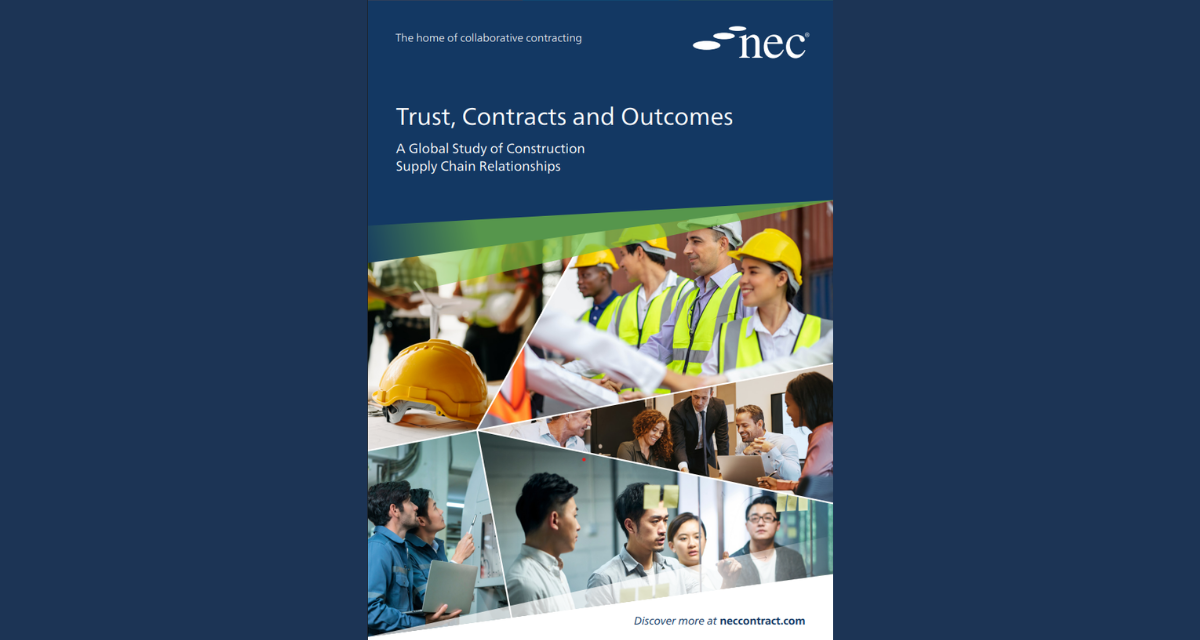
The NEC Trust, Contracts and Outcomes is built on insights from more than 1,000 professionals across five countries. It affirms that the all over the world the construction industry broadly agrees on what “good” looks like – yet continues to operate in ways that undermine it. Sadly for most reading this article, nowhere is this tension more evident than in the UK.
For UK contractors, the findings are both familiar and unsettling.
The UK’s Adversarial Baseline
Across all markets surveyed, the industry describes itself as adversarial. But the UK data highlights how deeply entrenched that baseline has become.
UK respondents report:
- High levels of formal dispute resolution compared with global averages
- Lower reported trust between supply chain partners
- A strong belief that disputes are an “inevitable” feature of complex projects
This is particularly worrying as the report makes clear, adversarial behaviour is not incidental. It sets the tone for everything that follows: defensive contracts, late issue escalation, risk transfer to weaker parties, and a culture where commercial protection often outweighs project performance.
Payment Pressure Seen From the UK Perspective
Late payment culture too stands out sharply in the UK findings. While all markets identify payment as a source of instability, UK main contractors rate it as their single biggest commercial pressure – the highest figure recorded for any role in any country surveyed.
Crucially, the report does not treat late payment in isolation. It consistently presents it as part of a broader commercial environment characterised by:
- Poor estimating and job costing
- Uncontrolled scope change
- Risk being borne disproportionately by those with the least leverage
In UK supply chains, these pressures intersect. Payment stress rarely appears alone; it occurs alongside strained relationships, tightly amended contracts and a lack of early, open communication around cost and change.
Comparison With Other Markets
One of the strengths of the research is what it shows by contrast.
- Peru records the highest belief in trust and collaboration, but struggles with adoption – a gap driven by lack of enabling structures.
- Hong Kong shows how sustained public‑sector leadership and consistent use of collaborative contracts can shape expectations, particularly among early‑career professionals.
- Australia exhibits strong awareness of collaborative models, but ongoing stress at the subcontractor end of the chain, especially around payment.
The UK’s position is distinct. One in five UK respondents had never heard of collaborative contracts, and fewer than three in ten had worked under them – a surprisingly low figure for a market where NEC has been promoted for decades.
The result is an industry that knows what works, but does not apply it consistently outside major programmes.
Key conclusions
Whilst the grass may be a bit greener, it is clear that the problems are not radically different the world over. The core conclusions of the research are:
- Poor supply chain relationships directly damage productivity, profitability and business stability.
- Late payment, unmanaged change and poor estimating are symptoms of those relationships, not separate issues.
- Disputes are not inevitable; they are the predictable outcome of low‑trust, adversarial systems.
- Collaborative contracts reduce disputes, improve delivery performance and protect businesses – particularly those lower down the supply chain.
- Client behaviour is the single most powerful lever for change.
Ultimately contractors and consultants largely accept and understand the benefits of collaboration, but client‑led adoption remains inconsistent and contracts are routinely amended. Where traditional models dominate, familiar problems persist regardless of statutory payment protections or dispute mechanisms.
A Specifically UK Challenge
Perhaps the most telling UK finding is the “strict‑terms paradox”. UK respondents simultaneously agree that:
- The best supply chain relationships are based on trust and cooperation, and
- The most effective relationships are governed by strict contract terms.
The report resolves this tension by arguing that the industry does not need to choose between the two. The most effective contracts are both rigorous and relational – legally precise, but designed to support early communication, fair allocation of risk and timely resolution of commercial issues.
That insight goes to the heart of the UK problem. The issue is not a lack of rules, rights or remedies. The UK has strong payment legislation and widespread access to adjudication. The issue is that traditional contracting approaches still encourage behaviour that delays discussion, entrenches positions and treats disputes as an operational norm rather than a sign of system failure.
Conclusion: What the UK Data Points To
The NEC research does not single out the UK as uniquely broken – but it does show the UK as stuck. Compared with other markets, the UK combines high awareness of collaborative principles with relatively low penetration beyond the top tier and high tolerance of adversarial outcomes.
The report’s conclusion is not abstract or aspirational. It is practical and commercial: where collaborative contracts are specified clearly and led properly by clients, disputes fall, payment pressure eases, and supply chains stabilise. Where they are not, long‑standing problems repeat, regardless of how well understood they are.
For UK contractors, the message is less about discovering new solutions and more about applying existing ones consistently – particularly in how projects are procured, contracted and led from the outset.
One point to note is that whilst the NEC research identifies late payment culture as a leading driver of instability, particularly for UK main contractors and subcontractors. Whilst this is fair, for many contractors, “late payment” is rarely the root issue. More often, it is the surface expression of a deeper commercial disagreement that has not been addressed early enough: valuation.
Disagreement over the value of work done, variations instructed or compensation events assessed is common on complex projects. What is less common is open, timely discussion of those disagreements. In low‑trust environments, valuation disputes are frequently deferred, softened, or avoided altogether – until the only remaining pressure point is payment itself.
The evidence is already there. The question the report leaves the industry with is not whether collaboration works, but how we break stride and normalise good beyond the places it already succeeds.
An as ever this starts with a Well Reasoned Responsible No.
The full report can be downloaded here
