


Glenigan, has released their February 2026 edition of its Construction Review.
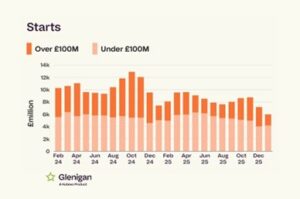
The Review focuses on the three months to the end of January 2026, covering all major (>£100m) and underlying (<£100m) projects, with all underlying figures seasonally adjusted.
It’s a report providing a detailed and comprehensive analysis of year-on-year construction data, giving built environment professionals a unique insight into sector performance over the past year.
Hitting the speed bumps
The February Construction Review reveals a general slowdown in UK construction activity as a persistently sluggish economy and low private investor confidence continue to suppress sector performance.
This overall malaise is highlighted by a 31% decline in project starts against the preceding three months to the end of January, with values slashed by a fifth (-20%) compared to 2025 figures.
Similarly, main contract awards tanked, plummeting by 43% compared to the previous year and tumbling by 37% on the preceding three months.
Likewise, detailed planning approvals fell by 30% during the Review period to finish a third down (-33%) on 2025 levels.
Sluggish demand growth and rising production costs at the back end of last year have taken their toll, with the industry struggling to find a firm footing from which to relaunch. Furthermore, the stronger consumer spending, typically seen in the run-up to the festive period, has tailed off. A recent uptick in unemployment will put pressure on household incomes, affecting the residential property market and, in turn, the sector at large. This downturn was perfectly encapsulated in the Q4 2025 UK growth figures, released last week, which saw GDP increase by a frustratingly pathetic 0.1%.
However, it’s not all doom and gloom, with the latest CIPS survey recording a strengthening in service sector activity, stabilisation in manufacturing output and a gradual moderation in construction activity decline.
Commenting on the February Review, Glenigan’s Economic Director, Allan Wilen, says, “Despite the disappointing numbers, there’s definitely hope on the horizon. The latest CIPS figures should inspire some optimism across certain quarters of the construction sector, particularly those involved in public works. A handful of key schemes, including the Hospitals Programme, the Schools Building Programme and a strong pipeline of infrastructure and utilities upgrades are set to kick-start UK construction out of neutral.”
He adds, “Of course an early interest rate cut would not only do wonders to restore dwindling consumer and business confidence, but also help get Britain building again.”
Taking a closer look at the key highlights from this month’s Review…
Education, education, education
A mixed picture emerged for education projects during the three months to January. Project starts surged by 29% against the previous year and detailed planning approvals rose by 11% compared to the preceding three months, though main contract awards declined by 28% over the same period. Despite this uneven performance, there are reasons for optimism in the sector, with the school rebuilding programme providing around £2.4 billion in annual commitment, alongside additional RAAC funding.
Schools dominated activity, accounting for 72% of starts, with the sector growing 33% year on year. Universities represented 18% of starts with activity increasing 55% year on year, while colleges were up by 9% year on year.
Regionally, London-led project starts (22% of total value), recording a 182% year-on-year increase, while Scotland saw the sharpest growth, rising 319% year on year. In planning approvals, Scotland held the largest share at 37%, increasing 147% year on year, with London and Yorkshire & the Humber also recording triple-digit growth.
Community values
Community & Amenity delivered a relatively strong performance during the three months to January, with project starts surging 125% year-on-year and main contract awards increasing 22% from last year. Major project starts and awards performed especially well, with strong increases against both the previous three months and last year, though detailed planning approvals fell 34% compared to 2025, with no major projects approved during the period.
Prisons dominated activity, accounting for 63% of starts, thanks to 262% growth, while government buildings increased 207%. Conversely, local facilities were down 7% year-on-year, with only half the sub-sectors seeing an increase in project starts overall.
The East Midlands accounted for the largest share of project starts, rising more than 23-fold, whilst the North West (11% of total starts) grew four times compared with the previous year. In detailed planning approvals, Wales also had a good Review period, accounting for 35% of the total, with approvals rising 450% year on year, while the North West grew more than 11-fold.
Planning for improvement
Residential project starts and main contract awards experienced a decline against both last year and the preceding quarter, with starts down 24% year-on-year, main contract awards declined 33% from last year, and detailed planning approvals decreased 34% year-on-year.
On a more positive note, there was growth in detailed planning approvals against the previous quarter, while major project starts are also showing signs of recovery. With UK house prices rising in January, the outlook for the housing sector appears promising despite experiencing a weak quarter, with private housing and social housing forecast to rise by 6% in 2026.
Sub-vertical performance was mixed, with private housing accounting for the largest share of starts at 38%, having decreased 51% year-on-year, while private apartments grew by 43% against the previous year. Social sector housing started on site grew 3% compared to a year ago.
The North West led residential project starts, thanks to an 87% increase, while London performed poorly. The South East was the most active region in planning approval terms, despite falling 30% year-on-year, while the North West bucked the trend with approvals increasing 8%.
