

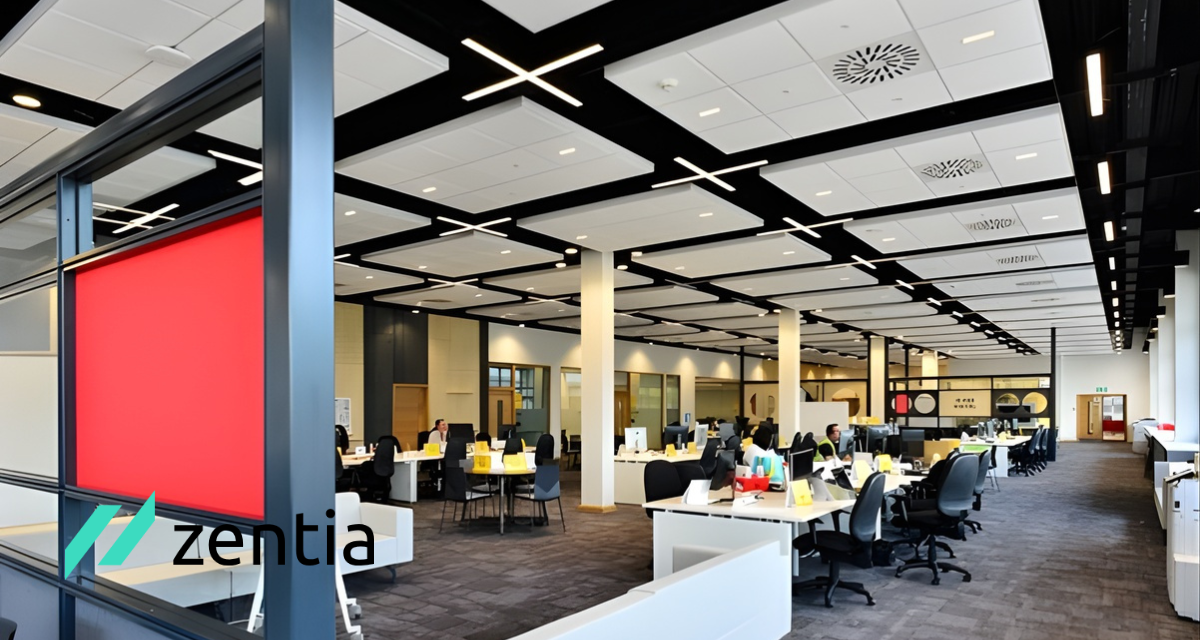
While the education sector has long benefited from clear, measurable guidance through BB93 (Building Bulletin 93), which sets defined acoustic performance criteria for schools, commercial offices remain largely unregulated in this respect. Despite offices being hubs of collaboration, conversation, and focused work, there is currently no formal acoustic standard to govern how they should sound. The result is huge variation in acoustic quality from one project to the next, with many contemporary workplaces prioritising aesthetic trends at the expense of comfort, concentration, and wellbeing.
The consequences are far from trivial. Leesman’s global workplace data consistently shows that over half of employees feel their environment fails to support core aspects of comfort, including focus, privacy, and noise control. Workplaces may be visually striking, but poor acoustics can reduce productivity, elevate stress levels, and hinder collaboration.
Intentional acoustic design
Zentia advocates for intentional acoustic design, a strategic approach that ensures spaces are not only visually compelling but also functionally sound. Every design decision, from high-level fit-out choices to the acoustic requirements of individual rooms, is made with purpose. Acoustic comfort is defined around three key principles: clarity (ensuring speech and sound are intelligible), concentration (minimising distractions in focus-driven areas), and confidentiality (supporting privacy and controlled sound transmission).
Achieving these outcomes requires careful consideration of both materials and layout. Continuous ceilings, fully integrated grids and tiles, create uniform acoustic performance across large areas while maintaining easy service access. Floating rafts and baffles, such as the Sonify range, allow targeted sound control in specific zones and offer flexible design options, while vertical wall absorbers help reduce reverberation, improve speech clarity, and support privacy. Crucially, performance depends not just on adding absorbent surfaces, but on selecting materials with the right properties for each space, including absorption, attenuation, density, surface finish, and even interaction with lighting and mechanical systems.
Performance, sustainability, and wellbeing
Acoustic design does not exist in isolation. A truly future-ready office must integrate comfort, wellbeing, and sustainability. Zentia’s ceiling and wall systems use low-VOC materials to support healthy indoor air quality, hygienic surfaces for easy maintenance, and robust, long-life performance to reduce premature replacement. These attributes support recognised sustainability frameworks such as BREEAM, LEED, and WELL, helping design teams meet evolving environmental and regulatory goals.
By considering acoustics, material performance, and environmental impact together, architects and specifiers can create offices that are not only visually striking but also genuinely functional and sustainable. Acoustic comfort becomes part of a holistic approach that enhances employee experience, improves focus, and fosters a sense of pride in the workplace.
Evidence-based design
Workplace design must be guided by evidence. Noise remains one of the most critical barriers to a positive employee experience, impacting focus, privacy, and collaboration. Zentia bridges the gap between problem and solution with UK-manufactured ceiling and wall systems that combine measurable acoustic performance with industry-leading reliability. Their digital design tools streamline modelling and planning, ensuring acoustic strategies align with architectural intent from concept to completion.
Importantly, support does not stop at specification. Zentia works alongside architects, contractors, and end-users throughout the design and installation process, ensuring acoustic performance is integrated from the outset rather than applied as a retrofit solution. Long-term warranties of up to 30 years provide additional reassurance and reduce lifecycle costs, allowing clients to invest confidently in acoustic solutions that endure.
A workplace is not great simply because it is new. It becomes great when it enables people to think clearly, collaborate comfortably, and feel proud to be there. Leesman puts it succinctly: “A new workplace is no guarantee.” With intentional acoustic design, however, offices can deliver something far more meaningful – a space that truly works for the people inside it. By combining performance, sustainability, and aesthetics, Zentia enables workplaces to achieve this vision, setting a benchmark for what acoustic excellence can look like in modern commercial environments.
