

Dr Noble Francis, Economics Director at the Construction Products Association (CPA), shares his thoughts on construction output, which is forecast to grow by 1.7% in 2026, with housing weakness offset by growth elsewhere despite ongoing cost and skills pressures.
Construction activity in 2026 is in a similar position to how it was last year, with subdued activity in the largest construction sectors, such as housing new build and repair, maintenance, and improvement (rm&i), offset by growth in key niche areas including commercial refurbishment and fit-out, data centres and infrastructure. Last year was challenging for many firms across the construction supply chain, and this year is likely to be equally challenging. However, there remain key opportunities for firms working in those key niche growth areas.
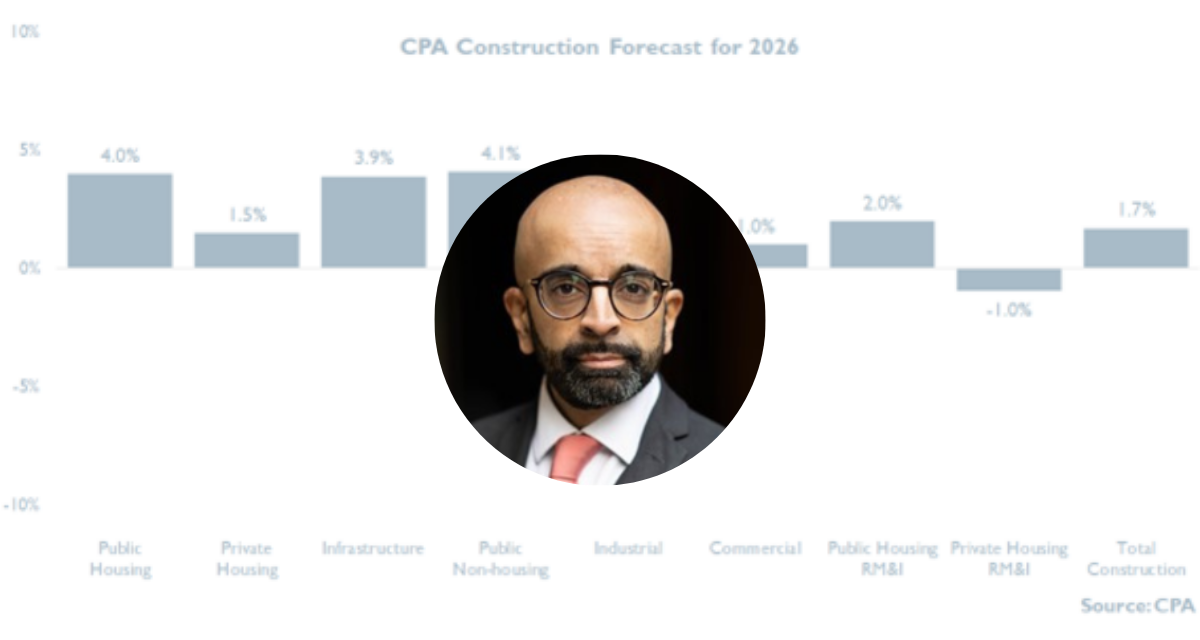
Overall, construction activity is forecast to grow by 1.7% in 2026. On the positive side, the uncertainty surrounding the Autumn Budget, which affected homeowners, homebuyers, businesses, clients, and investors, was over in November. In addition, gradual interest rate cuts are expected to support both consumers and businesses.
House building
Activity in house building, the largest construction sector, began to recover at the start of 2025 but tailed off sharply after April. It remained subdued coming into this year, as affordability is a key constraint in higher-priced parts of the country, while site viability is a key problem in lower-priced areas. High-rise residential developments are affected by substantial delays at the Building Safety Regulator (BSR), even after planning approval, particularly in London.
Housing repair, maintenance, and improvement
Overall, private housing is forecast to grow by 1.5% this year. Housing rm&i, the second largest construction sector, also remains subdued. This is despite many homeowners having finance available for home improvement as homeowners have chosen to save rather than spend, especially on big-ticket items, as consumer confidence remains poor and uncertainty remains high.
Commercial construction
Commercial construction experienced mixed fortunes in 2025, and this is likely to remain the case this year as well.
For firms working on smaller, high-end, high-value refurbishment and fit-out, activity remains very strong and is expected to continue over the next few years, as around 70% of the commercial building stock needs retrofitting to avoid becoming stranded assets that cannot be let due to energy efficiency standards from 2030.
In addition, demand is focused on grade ‘A’ quality office space, where the vacancy rate is likely to fall to zero in the coming years.
However, new large commercial developments, including ‘back-to-frame’ refurbishment projects, which often cost £150-200 million, are increasingly difficult to justify given the excess existing building stock, especially with high construction and financing costs remaining major challenges, and investors are adopting a ‘wait-and-see’ attitude to increased uncertainty. There are a few projects in the pipeline, but they keep being pushed back.
Student accommodation investment and university construction activity remain strong despite financial pressures on some universities, but there are still BSR delays on new student accommodation projects at Gateway stages 2 and 3. Overall, commercial output is expected to rise by 1.0% this year.
Public non-housing sector
One key area where growth is expected is the public non-housing sector, which primarily includes education, health, defence, and prisons. Activity on the Schools Rebuilding Programme appears to be accelerating, and future waves of the programme should now come through more quickly.
An increase in long-term capital funding for defence is also expected to drive significant growth. While activity on the New Hospital Programme has historically been slow to materialise, it is likely to accelerate from a low base. The Government also intends to increase investment in prison, probation, and court capacity. However, the ability to deliver projects on the ground remains a critical constraint. Delivery has been poor to date, and despite strong increases in investment, growth in this sector is still expected to reach only 4.1% in 2026.
Looking at key risks
On the positive side, if consumer, business, and client confidence improves, this could drive stronger UK economic and construction growth. In addition, two further interest rate cuts this year, in Spring and Autumn, are likely to support confidence, spending, and investment.
On the negative side, however, the construction sector continues to face the lagged impacts of the challenges from last year. These are likely to lead to more specialist subcontractor and small builders’ merchant insolvencies in the first half of this year. This is likely to be exacerbated by clients being more price sensitive and by main contractors putting pressure on the supply chain to avoid passing on cost increases.
Looking beyond this year, the biggest medium-term concerns are a lack of skilled trades. As an industry, we have lost a significant proportion of the old-age demographic of skilled trades in the last few years and they are not going to come back. Plus, we do not get enough new skilled trades into the industry. Construction apprenticeships, college places and skills bootcamps all have high dropout rates.
