

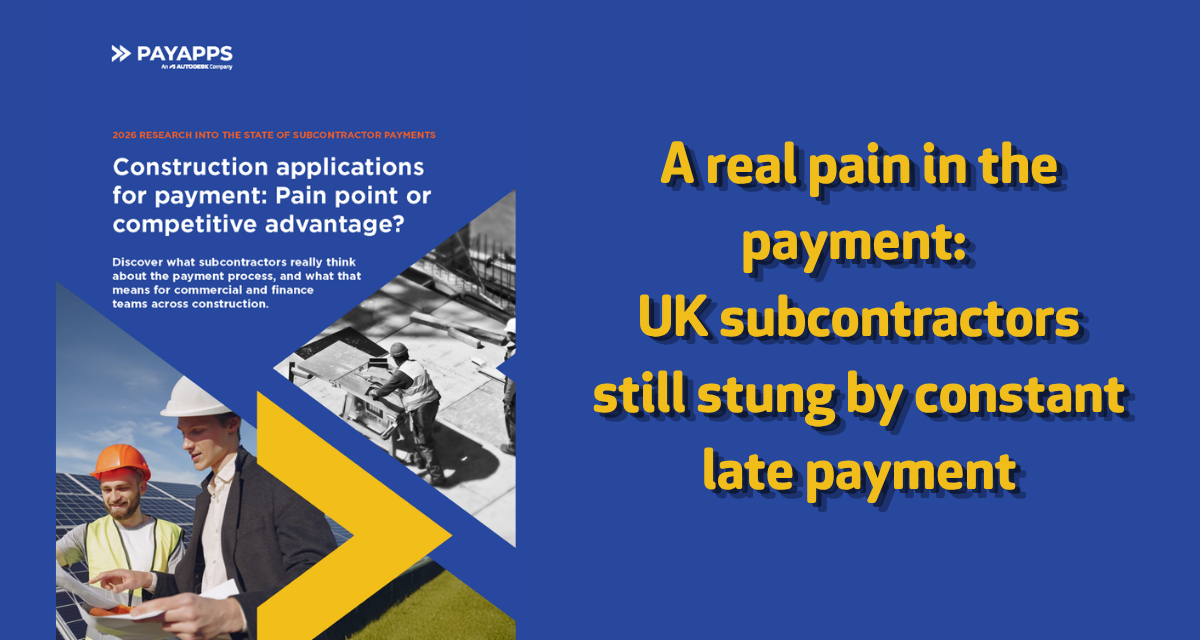
A newly released report from Payapps, an Autodesk company, draws attention to the shockingly inefficient payment processes UK subcontractors are still subjected to.
‘The Construction applications for payment: Pain point or competitive advantage?’ report surveyed 127 industry professionals across UK subcontractor firms to identify industry trends and attitudes towards submitting applications for payment and contractors’ payment processes. Worryingly, it revealed the majority (79%) are almost always paid late.
With less than half (46%) of firms also regularly receiving feedback or payment notices on time, the report points towards an increasing need for greater transparency, reduced admin time and standardisation within applications for payment processes.
A concerning point of contention
The figures validate an acute point of contention in the construction industry surrounding prompt payment for services delivered, with almost three quarters (73%) of subcontractors experiencing routine disputes over payment applications and processes.
Furthermore, nearly eight in ten (79%) say ‘variations not agreed’ between parties are one of the top five causes of disputes over applications for payment, while 74% report that valuation differences and time-consuming back-and-forth over completed work are within the top five reasons.
Blacklisted from doing business
Yet disputes are just the tip of a very unwelcome iceberg that many contractors are unwittingly heading towards. Late payments are becoming a systematic problem and one which the report shows contractors need to urgently address as it’s starting to seriously affect their operational capabilities.
The research uncovered the growing, negative trend that recurring disputes erode subcontractors’ trust in being paid on time, even leading some to blacklist certain contractors. Almost a third of respondents (29%) have avoided doing business with a contractor whose application for payment process proved ’too difficult’ in the past. 84% of subcontractors say a contractor’s reputation influences their decision to bid/price future work for them and 68% have increased their rates or added risk margin due to slow or unreliable payments.
These figures are hard to ignore and ones which contractors need to pay attention to, given the tight knit community that subcontractors operate in, and the power of word of mouth, especially as skilled labour becomes increasingly scarce and competition for contracts fiercer. Contractors are being judged, and good payment practices are becoming a competitive advantage.
Overwhelmed by an admin avalanche
Payapps also found that, within the calendar month, inconsistent instructions and confusion around payment application formats contribute to a significant loss of time for subcontractors’ already-stretched finance teams.
More than half (55%) spend over 20 hours a month on general admin, and when you dig deeper, applications for payment are a particular thorn in the side. Now factor in the volume: almost a quarter of those polled (24%) submit between 11 and 30 applications a month.
With respondents estimating that applications take 1.5hrs each, that accounts for the best part of a working day on average each month; which, with better processes and digital support could be clawed back from higher value tasks. There’s also a question of quality, with more than a fifth (22%) of applications often or always requiring corrections or additional information.
When the load builds up like this, something has to give, especially as subcontractors are often obliged to fit in application for payment work wherever possible (15%) or even resorting to processing applications after hours (17%).
Commenting on the report, Anthony Puma from Payapps, who has worked with the construction industry for over 20 years, says: “These results are troubling, especially during such a tough time for the sector; whilst margins are tighter than ever, there should be no reason to normalise delayed payments. The data proves that both parties are losing time and money to outdated, inconsistent processes and much of that is down to subcontractors having to relearn a different process for every contractor they work with.
“It’s an unfair situation and needs to be tackled sooner than later, especially when the sector eventually picks up pace and project delivery spikes. We know from the research that greater consistency and transparency instils greater confidence in subcontractors when it comes to a contractor’s payment process. Standardising and digitising the application for payment process gives people their time back to do the work that matters and helps them rebuild their trust in contractors.”
For the complete picture, download the ‘Construction applications for payment: Pain point or competitive advantage?’ report.
